Saturday, May 11, 2013

Halfway into the spring season


Gebel el Silsila Survey Team spring 2013


Madam Silsila, mother of a vast amount of Upper Egyptian sandstone temples, keeps opening her box of secrets to us as each day goes by. Like Adrienn briefly reported last week we were thrilled when John and Ahmed Sayed (general inspector from Kom Ombo and a good friend who made us the honour of joining in this specific day) found two intact oil lamps and another fragmentary one; this as part of making some great progress in locating another living/workmen’s quarter embedded within the huge spoil heaps. As part of the survey of this area John and Mohamed (our inspector) documented a small stone structure on top of one of the hills that had captured our interest already before. Working on top of a small hill in constant sunlight in the middle of May is not always an easy task, but our brave and persistent topographers made their best effort and soon presented great results! John will tell you more about this work in a few days, but even before that I would like to praise both John and Mohamed for their great work, which has resulted in important information about Silsila not only from the ancient side of things, but also from the continuation of the site and more interestingly the continuation of religious practice! Since I have not written a blog post myself lately, I would like to take the opportunity to say thank you to our previous inspector, Mohamed Abdulla, and at the same time welcome our new inspector, Mohamen Mohsen to the team.

John and Ahmed Sayed very happy over their oil lamps!

Mohamed Mohsen in photo action

recording of a fallen wall

Roman red bricks

For Adrienn and me, this fourth week meant returning to the main quarry where we worked last year. From a very personal perspective returning to this large quarry always brings with it an emotion similar to returning home, and regardless of how many times one has viewed the details of the gigantic quarry walls, there is always more to find! This fact is known to almost every epigrapher and rock art recorder out there and the importance of returning to a site during different hours (and even seasons) and in different light cannot be stated enough (yes, I know I have said it before). So, Adrienn’s “harvest” of this week contained another few interesting inscriptions and for me I was happy to locate some painted pictorial graffiti as well as various etchings that had escaped me previously. Also, it was not only our topographic “department” that was successful in finding interesting items this week. Four sandstone fragments were found with pictorial representations; one of which depicted an armed soldier holding a shield and spear! More information about these findings will be revealed as soon as we can!

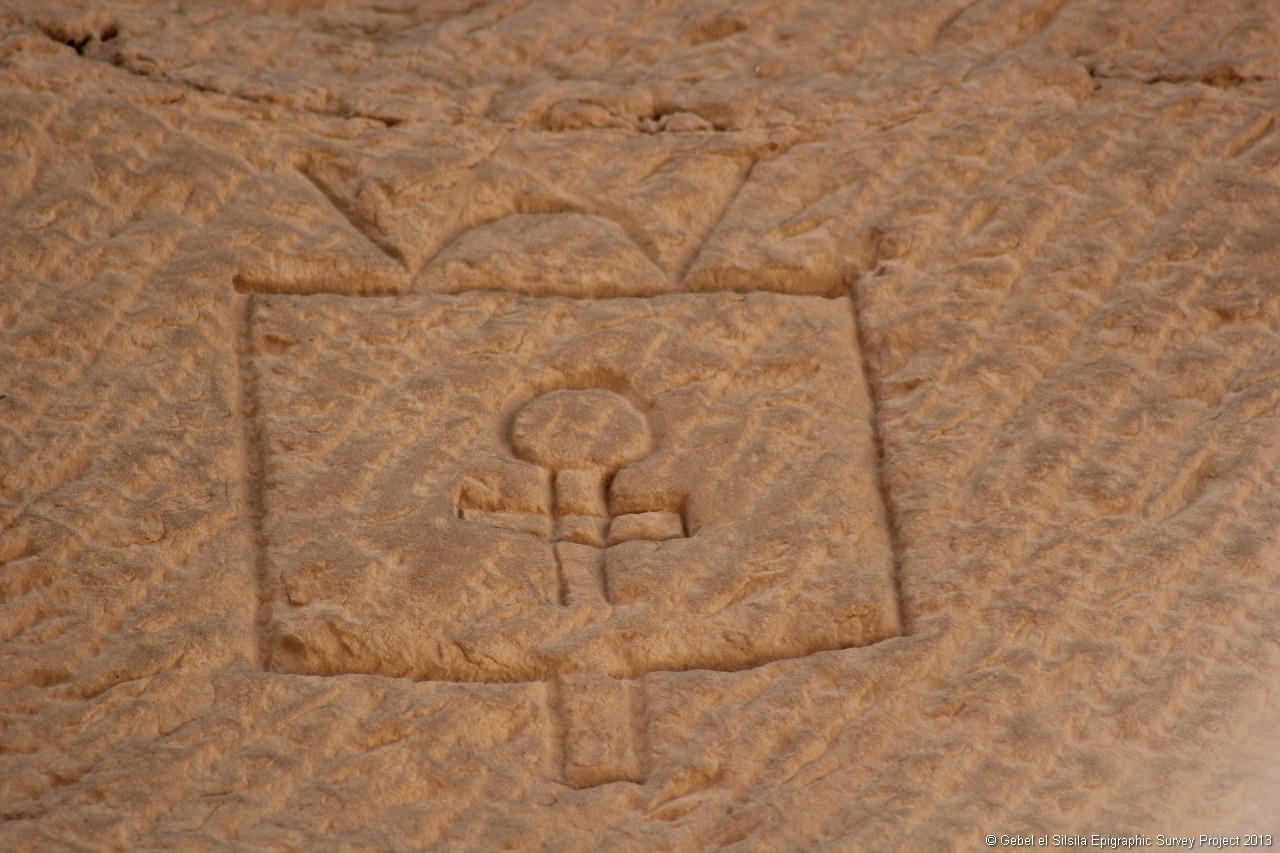
one of many quarry marks recorded


As many of you know, Egypt celebrated Sham el Nessim this week and it was a pleasure hearing and watching all families that came to visit Silsila to swim, enjoy each other’s company and mark the beginning of the summer. Meanwhile we took the opportunity of enjoying the beauty of Silsila West’s many monuments, strolling along the riverbank and appreciating the environment in which we work. Returning to Silsila East again on Tuesday I was once again reminded of Silsila’s beauty and still so untouched natural surroundings as I was joined in the main quarry by not only one, but four (!) absolutely gorgeous owls (type Pharaoh’s eagle owl, I believe). It was an entire family with two very fluffy youngsters, with their nest just in front of one of my personal favourite quarry walls. The first day of my “arrival” Mother Owl looked at me with suspicion in her eye, but somehow I caught her interest since she and one of her youngsters kept following me from one place to another, usually with some 15-20 meters between us and at a safe high location. On the third day she felt relaxed enough to introduce also the second youngster, at the same time as she no longer felt the need of keeping watch all the time, allowing herself a nap in front of me. For some of you, you already know of my love for animals and how much I appreciate these moments when nature present herself in her most beautiful way, so I need not say how much these three days meant for me!

Adrienn and her husband enjoying a day off at Silsila West during Sham el Nessim

Also I loved our stroll on the West Bank

one of many beautiful scenes from our floating survey home

Pharaoh's Eagle Owl, youngster

"My" Owl family with mum and youngster to the left, daddy and another sibling well hidden behind a rock to the right

Anyway, I will end my little week report inspired by the words of Cruz-Uribe as he expressed it in his April fool email (on the EEF List/forum): much of the work was the same from one day to another, maybe there will be more to report next time... ["I looked at some Demotic graffiti. My inspector refused to climb the ladder up to the top so I had to go by myself.  Nice views and so good shots of some graffiti."  Maybe next field season will be a bit more exciting.” EEF: An April 1 Report of News From Egypt]

Thank you as always for doing us the honor and following our work!

Maria

our new generator is delivered!

four souls with the wish of being remembered 


one of the youngsters

fluffy young owl

mummy owl

third day in an mummy owl starts to relax having me around

another fluffy image 

Silsila at its best!


Tuesday, May 07, 2013

Silsila from a topographer’s perspective


Blog entry by

Dr. John Ward


As some of you may already know, I spent the last 3 weeks not only working with the topographic material on site, but also tried juggling with the last remaining chapters of my forthcoming book. Thankfully, the book has been sent in for the editors to work with, which now gives me the opportunity to write a small blog entry on the current topographic recording on site.


During the first three weeks of this our second season at Silsila, I completed the first phase of the topographic visual survey. This entailed three hills that rise above and beyond the Main Quarry where we worked last year, as well as the Situla Quarry, Graveyard Quarry and Naos Quarry (all our personal and thus unofficial quarry labels). These four named quarries have been the focus of both Adrienne and Maria as they continue to record and document the inscriptions, quarry marks and other graffiti that line and mark the quarry faces.


Starting with the area that I refer to as ‘Situla Hill’, which rises to the south of the Main Quarry and contains within its upper section the Situla Quarry (hence its name), I first began by observing the block-storage that is located at the summit of the hill as it meets the ancient pathway/trade route that runs from the north to the south of the mountain. Since there are various block-storages in this area, I numbered this particular block-store ‘1’. Already during our last season it had become apparent that I had to separate the stores to correspond not only with the respective hills, but also their respective quarries. Recording the block-storage and its immediate surroundings was a labor intensive task, especially as I was situated on top of the mountain without the otherwise optional shade of the quarry faces or the benefit on being on the level ground. Each morning I had to climb up and down the hills, focusing my attention to the details, some that are sometimes hidden within the eroded and occasionally interfered landscape.


Similar to ‘Situla Hill’ the other explored and recorded hills were (nick-) named after their respective quarries and landscape features; thus, we have Graveyard Hill and Pigment pit Hill. In-between these three hills I also had the pleasure of recording the valleys or ‘wadis’ as we know them here in Egypt. Corresponding with the hills’ names, these wadis were divided into manageable workloads:

1: Situla Hill

2: Block Store 1

3: Situla Quarry (Upper Section)

4: Situla Wadi

5: Graveyard Hill

6: Block Store 2

7: Graveyard Quarry (Upper Section)

8: Graveyard Wadi

9: Block Store 3

10: Block Store 4

11: Pigment Pit Hill

12: Block Store 5


Now, within these 12 sections there were various areas that had received specific interference, either contemporary with the quarries or at a later date. This plateau landscape was mainly made up of the blackish, loose top-stone (a familiar sight for anyone who walked in any of the mountainous areas across Egypt) interspersed with heaps of spoil that once came out of the below situated quarries. There at the plateau I numbered and recorded the numerous minor surface quarries; areas where the ancients had taken advantage of exposed sandstone outcrops. These were usually quarried in an ad-hoc manner, but the ancients effectively removed any and all useful stone from its protruding location.


Amongst these open surfaced quarries and the pathways that meander throughout the hills, I also recorded the innumerable amount of what I first thought were ‘camel troughs’, but later turned out to be pigment pits; these are strewn all over Silsila landscape. The ancients had obviously taken advantage of the upper natural veins of the surface, which provided them with a white substance that as yet I have to identify (possibly chalk, lime, or in fact a dioxide, similar to titanium). After conducting a few on site archaeological experiments using the white powder on the surface, I was able to determine that its application to a sound surface was an effective pigment that completely whitened the surface. If it was mixed with a little bit of water it became more paste-like and not as easy to apply to a surface, similar to a plaster for instance. So, finding the white pigment clearly solved my previous conundrum over these pits that litter the landscape.


Overall the topographical visual survey has highlighted many manmade features that have been installed to benefit the extraction of stone and their subsequent removal from site, which I am sure we will publish in due course. The relationship between the three hills and the surrounding quarries was a delight to understand and evaluate. Equally it is great how one is able in essence to understand the various periods of quarrying just by reading the landscape, explaining how the work was carried out and how overlapping work periods have affected the obvious landmarks that we see today; each detail, each element provide us with a tangible timeline of events.


Unfortunately, I still have no main shelters or an infrastructure to present to you that would suggest permanent habitation or a community living and thriving above the quarries. Thus, the quest for that particular question still remains. Hopefully I will be able to bring you something in the near future.


Thank you

John

ps. images will follow during the weekend... 


Saturday, May 04, 2013

A week report from the “linguistic department”


Although the summer arrived this week to Silsila, bringing almost extreme heat and making our work harder also because of the strong direct sunlight on the quarry faces, the first morning provided us with a good omen: we saw a scorpion in the camp! The little green creature was hiding in our folded camping chair left overnight in site, but following the ancient Egyptian tradition, we thanked Ma’at for bringing us this sign of fortune!    

As John had urgent work on the boat (will be reported on in more detail in the weekly report from the “topographical department’s” point of view) the first two days us girls spent some quality time in the quarry. I continued the documentation of textual inscriptions while Maria measured and photographed the southern section of the quarry with all its quarry marks and technical remains from extraction.
   
This was our last week in this particular quarry so I had to double check that I had documented every inscription properly. Since the changing of the sunlight (with its shades or direct sunlight on the surface) often makes texts invisible I was not surprised when I found new (mostly painted) inscriptions especially in the corridor. These are (unfortunately) fragmentary and blurry; however, one demotic inscription contains the word Caesar combined with numbers written after the noun “stone”. In my opinion it is another dedication to Isis, who was the protector-goddess of this quarry and with various similar texts in the immediate surroundings, and with the author’s personal comment telling us how many blocks he extracted that specific day.

As known before and now confirmed in more detail than previously, the extraction for the Esna barrage in 1906 destroyed a few ancient inscriptions and quarry marks, but to our relief the number can be limited to only six now missing inscriptions based on the documentation of Legrain, Spigelberg and Preisigke. Comparing the current layout of the quarry with the accounts of Legrain, two ancient quarry faces were removed between 1906 and 1909. We are still searching for Legrain’s reference of a few-lined text curved next to an Isis figure in the quay; a search made more difficult due to the incorrectness of Legrain’s map. I hope we will find it soon.

This week we welcomed our new inspector to our site; Mr. Mohamed Mohsen! He is a nice man and enthusiastic about the work in Sislila and he is the youngest inspector at Kom Ombo. I think he finds the topographical work more interesting than the epigraphical since he assisted John in the open sunlight during the last days in spite of the heat.   

The best event of the week, when we were all “on top of the world” (Imagine Dragon’s song that Maria plays for us each morning to keep the spirit up) was when John and Ahmed Sayed found two Roman oil lamps tucked in between two stone blocks in the ruins of a collapsed building. They are intact and beautiful having even the wick inside (more reports on these later).

Living on a dahabeya is an elegant adventure taking us back to the beginning of the 20th century, but it includes an interesting wildlife experience as well. The boat has been anchored next a reed-bed populated by animals. Birds are flying over us, picking up crumbs from the floor and unknown quadruped eats from our garbage during the night.           

Thank you

Dr. Adrienn Almasy

Saturday, April 27, 2013

First two weeks


Time flies when having a great time, and indeed the two first weeks of our survey work passed so quickly. We were told that we are late during our meeting in Aswan, when there to fill in the last paperwork before heading up to Silsila via the Kom Ombo office. “Late” one may then ask. Well, easily understood due to the rising temperature we are late into the spring to start a new season, and apparently there are only two foreign archaeological missions out there in the field at this time, fighting back the sweat while appreciating the sun’s illumination of inscribed details of the quarry walls or rocks. Funny enough, both missions are headed by a Maria; alongside our work, Dr. Maria Gatto’s concession continues deep into the Aswan wadis, exploring the telltale signs of the ancients in the area. We very much look forward hearing about her and her team’s work in the end of the season!

Sunrise over Silsila

After last year’s somewhat dreadful choice of accommodation in Aswan, forcing us to drive the 1-1.5 hours back and forwards from site every single day, we are now more than happy about the choice for this season: we currently call a small, but sufficient dahabeya our floating survey home for the six weeks we are out there. This dahabeya made her first journey in 1906, built to carry stone for Edfu, and was not made into a more serene function until more recent years. Her name has brought us many smiles, and for sure will continue to do, as she is called “Rehab”. For any fieldworking archaeologist or surveyor, Rehab is of course a quite appropriate name as it offers a bit of relaxation and recuperation after a long day out in the sun. However, this British built boat, with a French description of her first day of setting sail, has a name which in Arabic is a common female name and relates to the garden of heaven, but which in common tongue also expresses a warm greeting. So, after all, we are happy to call the Rehab our floating home for this time, and for sure she enables us some more quality time away from the Aswan road and instead we can enjoy a spectacular view of the entire site of Silsila with its cenotaphs, stelai, shrines, quarries, and of course the Speos of Horemheb below which we anchored.

Rehab

Our much appreciated view from our floating survey home

Moving on from last season’s work in the main quarry, Adrienn and I carried on with our documentation in the smaller quarry that is located directly to the south; a quarry which goes by the nickname “Situla quarry” after its more common depiction, or Q35 in topographical terms. Since Adrienn recorded almost all the inscriptions during our previous season, she stayed with me for only a day to go through it once again and make sure there were no details missing. Any epigrapher or rock art fantast will know too well the importance of light as texts, images, and even the smallest details can be fully visible in shade but not in sunlight, or more often, the other way around. Q35 held my attention for several days, almost the entire first week, as each quarry face was recorded separately with details of not only epigraphic material, but also quarrying techniques including tool mark patterns, block sizes, foot holes, rope holes, post holes, wedge marks, splitting marks, trench preparation, etc. etc. Our inspector, bless him, quickly moved on from my documentation to spend more interesting time with John who is responsible for the topographical data recording, and became engaged in John’s vivid description of the various transportation roads that had been in use during the time of quarrying.

Documentation in Q35

Documentation in Q35
blocks in the "graveyard"

After spending a lovely weekend strolling along the Nile, viewing and admiring the (for many of you well known) cenotaphs and stelai, we returned to our dahabeya where we were presented with a most action packed scenery. The guardians of Silsila had caught looters not only on one side, but both of Silsila’s banks. Due to the guardians’ fast actions, combined with the arrival of the entire director’s office of Kom Ombo, followed by the police, eleven men were arrested before our eyes, and we could not have felt any prouder of Silsila’s protectors!

John with one of our guardians

Encouraged by what we had seen during the weekend, we returned for a new week’s work, ready to take on the challenges of Q36 and Q37. Q36 received its nickname “the graveyard quarry” as it is embedded in an area with large stone blocks that lay scattered in a fashion reminding of a cemetery. These blocks had been extracted from the upper strata and consist of a rather poor texture quality, obviously of little use for the Romans who demanded top quality. Q37 is unofficially called the “Naos Quarry”, called so after a small rectangular room on top of one of a quarry wall and partially sitting on a large spoil heap. Although it is more likely that this room was used for storage or a more practical function, its location (surrounded with various adoration inscriptions) and its three megalithic roof blocks inspired to its nickname. Similar to the main quarry, many of the textual inscriptions were published in 1915 by Spiegelberg and Preisigke following the notes and drawings of Legrain. For sure, also Caminos and his students must have been captivated by the natural splendor that this large quarry presents, but as time moves forward so does technology and we are so pleased to be able to use great camera equipment that enables us to capture in detail every minor element of inscriptions and images that are located on the uppermost levels of the quarry walls. We very much look forward sharing some of these images with you eventually!

Adrienn in Q37

Talking about photographs, we must share with you our sunshine story of true modern heroes! If it was not for the great deeds of Dyan Hilton and Peter Allingham our photographic work at Silsila would have been forced to an end already before it really got started. One afternoon both our canon battery chargers blew due to an electric problem on the dahabeya. Panic did not wait to make its entry, emphasized even more by the fact that these chargers were not to be found within Egypt (although Peter, Adrienn’s husband, managed to locate a universal charger eventually). Searching for chargers online came to a dead end too, as none of the international companies offered express delivery. So, following John’s advice a cry for help was sent out on Facebook, asking if anyone was coming in to Egypt from Europe or America. Dyan Hilton kindly reposted and with her help Peter Allingham came to our rescue, having a group arriving the day after as part of the Ancient World Tours! With pure persistency, patience and the great will to help a fellow in need, Peter’s kindness resulted in two brand new chargers arriving in Luxor, saving the continuation of our work! So, thank you Dyan and Peter, and to the AWT group, for being true saviors!

still morning water

Returning to work; while Adrienn and I were enjoying at least partial shade in the naos quarry, John spent most of the first two weeks up on the very top of Silsila, documenting the ancient pathways, huts, ramps, transportation roads, and of course, the very informative spoil heaps. Of the more interesting findings were included two causeways that presented valuable information in terms of temporal work continuation and the change in work structure from one period to another. Other findings include prehistoric rock drawings and a pathway paved with carved feet; the latter soon received the nickname “commemoration road” due to the significance of foot graffiti. On our last day before breaking up camp for the weekend, we all joined up and walked off in a northern direction to spend the day surveying different quarrying techniques, aiding us in how to plan for our autumn season.

John in the "fallen monuments" area with his favorite piece:
the naos of Amenhotep son of Hapu


Before letting you go, I would like to continue on the note of gratitude, this time directed to Barbara O’Neill and the Egyptological team for giving me the honor of talking a bit about Silsila under “Egyptologically speaking”. Barbara interviewed me back in December, aiming to include her piece in the December journal, but as many of you know, Egyptological was hacked and forced to shut down temporarily. Thankfully Egyptological is now back up and running, stronger and more interesting than ever, and we would be so happy to support their great work!


With this been said, we thank you for your support in following us and our survey work at Silsila!

Maria

Sunrise over the speos

Friday, April 12, 2013

Start of a new season!


As the Khamseen howls around us and bringing summer and heat to our door step from the western desert we prepare ourselves for our next field season at Silsila. This year our season will be divided in two blocks of six weeks each, with a spring season beginning now on Monday 15th of April and planned to proceed until the end of May – probably a bit on the hot side towards the end, but we are pretty sure our love for archaeology and Egyptology will keep us going!


Still being a rather small team (although we look very much forward to welcome some new members for the autumn season) it is our aim to pick up where we left off last year and to continue to work in the smaller quarries that surround the main quarry. We will continue to carry on the overall photographic documentation of the individual quarry sections as part of the long term objective in creating a comprehensive topographical map of the area, labelling each individual quarry section and all epigraphic and archaeological material.

From an epigraphic perspective the documentation of the quarry mark system will continue along with other pictorial graffiti (Dr. Nilsson), Dr. Almasy will continue working with the textual inscriptions; from a general archaeological aspect, Dr. Ward will proceed in the topographic data recording (of course, once on site we will introduce you also to our inspector). In addition, we will look closer at the various extraction techniques by studying in more detail the tool marks, grooves and trenches, hopefully adding to the already very interesting information that has been brought to the table by Prof. Harrell and Dr. Storemyr


Proud followers in the footsteps of Ricardo Caminos and his students at the time we hope to contribute to previous epigraphic recording by including some more technologically developed techniques and to bring this material into its greater archaeological context. For sure, the team is very excited about our latest additions to the camera equipment and recording devices which will enable us to document in close-up details inscriptions and pictorial graffiti that are located at the highest levels of the sometimes 40 meter high quarry walls!

With that being said it is time to return to packing and preparations, but we hope that you will all join us by following us online during our work! Do not forget to follow us also on Facebook!

Thank you!


Wednesday, January 09, 2013

...and a big congratulation

... and a big congratulation to our linguist, Adrienn Almasy, who defended her doctoral thesis successfully just before the holidays! Thus, the Gebel el Silsila Epigraphic Survey Project welcomes Dr. Almasy!

Best wishes for a great new (archaeological) year

The Gebel el Silsila Epigraphic Survey Team sends out a somewhat late wish for a happy new year. For all scholars and researchers, may 2013 be a great archaeological year with exciting new information!