Saturday, March 29, 2014

Reporting live from the sherd yard


As our dear ceramic expert has now left the team after 4 weeks work, we thought it would be appropriate for Sarah to summarize the last couple of weeks and her first season’s work here at Silsila. All images in this blog post were captured by Sarah herself: 

'Reporting live from the sherd yard' 
by Sarah K. Doherty

Hello from the sherd yard at Gebel Silsila, where I thought I would give you an update on our proceedings in understanding the complex, at times surprising but always awe-inducing Madam Silsila. Since the last blog we have been very busy working through all the material from the various sites identified by John and Maria to be of interest (which seems like almost everywhere!). As Silsila is a relatively untouched site, we are fortunate that there is a lot of potential material around to study. The difficulty lies with where to select first for analysis! Under main consideration, as mentioned in other posts, is the Main Quarry (Q34) on the East Bank of Silsila where I have concentrated my efforts in pottery processing. This is the area that Maria and Adrienn have almost finalised the inscription and quarry mark survey (undertaken in previous seasons), John and Maria in analysis of quarrying techniques, John in recording of the topographical features, and I hope to complete the story with what pottery was being used, where and of what date.


John and Sarah washing and analysing sherds
When not busy (ha!) with the Main Quarry, I have also been trying to compare it with other sites located on the East and West Bank and surrounding wadis (which we have had fun naming e.g. Wadi Tean or Mud Valley). On the West Bank at Pottery Hill the surface contained more pottery than I could handle in this season alone (including several complete bowls), so I've used it for the preliminary data as the basis for a pottery typology on the site. Southern Hill (above the Main Quarry on the East Bank) alone yielded 4,000 sherds... The pottery in and around the 18th dynasty quarries that Maria and John have documented during previous seasons have to wait until next season, and with them also Wadi Tean, GeSE RAS 18-19, and not to mention the other areas yet to explore sherd-wise.

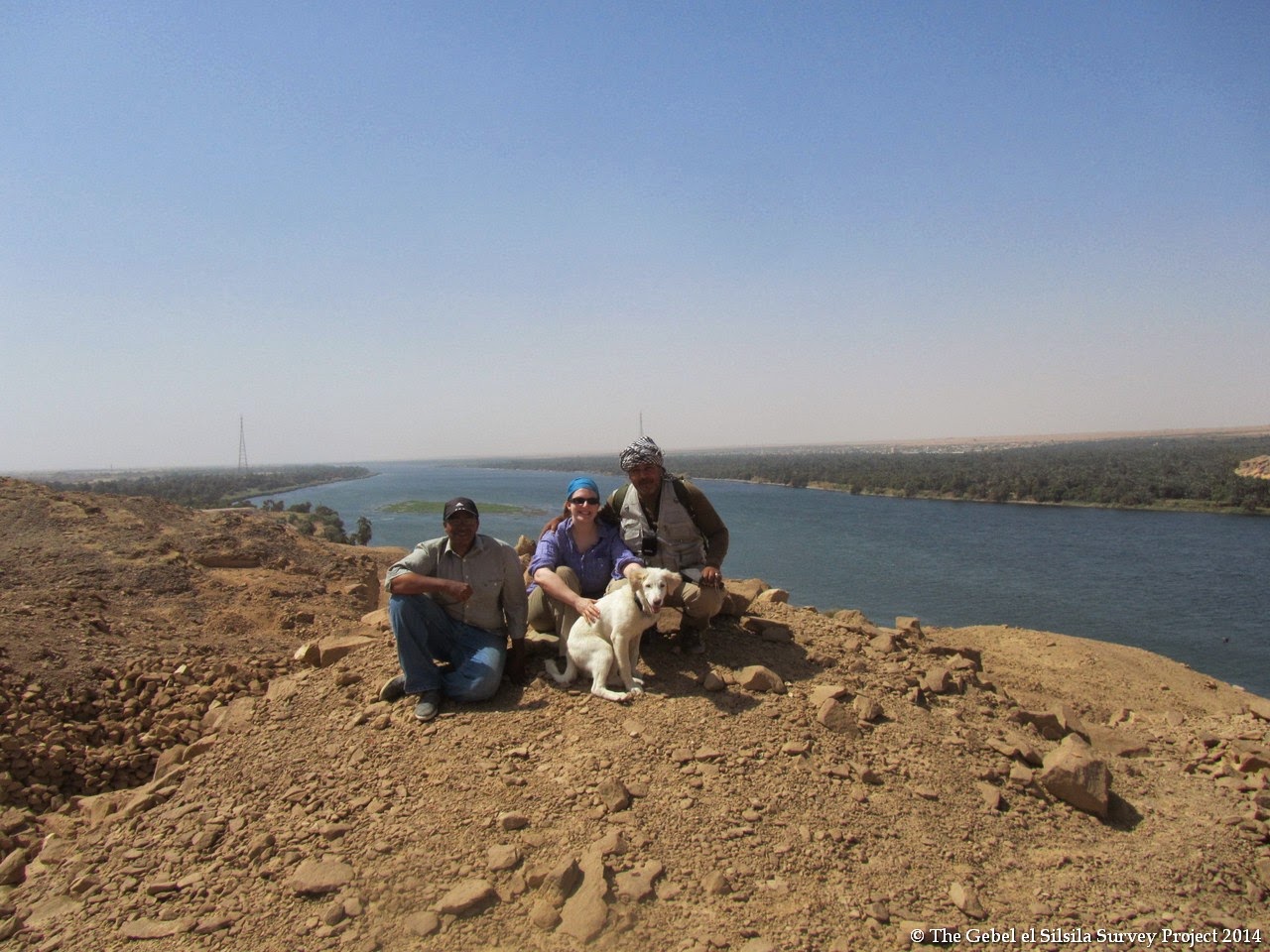
Great view from 'Southern Hill'
Measuring the (men's) width of a Roman road

There is so much potential at this site, I can't wait for the next season to begin. Post (my) season, for the coming months, I will spend my time with the delights of database entry, digitising drawings and 3D imaging of some of the completed vessels. 

Sarah K. Doherty sherd_nerd

[The Silsila Survey Team will surely miss our already greatly beloved ceramic analyst, and we all look forwards to the upcoming autumn season when she will return to site!]


Yup, there was still some "spare" time to explore the site's prehistoric rock art
A quick visit to Aswan for the UNESCO organized conference 'Southern Gate of Egypt' where the Silsila Survey Team was represented by Maria
We were honored by a day's visit by Dutch scholars and friends


I

Friday, March 21, 2014

Three weeks in

Equinox sunrise over Silsila

Third week into the spring season and the current survey team has experienced everything and anything from nature’s great forces – with lightning and thunder storms, rain and sand storms at the same time – to great achievements in the (historical!) very first archaeological attempt of setting up a classification system on site for both pottery and lithic industries. It goes without saying that we all have had a fabulous time, busy and full of new important information, and fantastic because of the positive, energetic and knowledgeable combination of team members!

The survey team first half of spring season

Since our last blog post Sarah has continued with her ceramic analysis, not only recording material from the Main Quarry (which was the main aim for this spring season), but also from the area known to the Silsila team as ‘Pottery Hill’. This latter area has been a concern since we begun working on site back in 2012, mainly since it is constantly threatened by environmental forces (wind erosion, etc.), but also because it is a habit for tourists to pick up bits and pieces only to later drop them in areas out of context. As always the Romans made their presence known at Silsila, and at Pottery Hills they revealed a few interesting and intriguing new pieces to the large jigsaw puzzle that Silsila offers, but as expected Pottery Hill revealed also Ramesside activity, and bits and bobs from both later and earlier periods. The intention is to continue to explore this area in more detail in the near future, to clear some of the huts/stone shelters from blown in sand and thus learning more about the ancient quarrymen and their organization.

Sarah, Mohammed and our posted policeman on top of a spoil heap

Sarah and Mohammed sorting pottery

Sarah demonstrating the importance of pottery for General Director of Kom Ombo, Abd el Menum

With Sarah, John, Ahmed, Mohammed and Shihad working on recording pottery and general topographical features at Pottery Hill, I (Maria) continued the Rock Art survey in this area and was pleased to note how the Epipalaeolithic rock art locations expanded and revealed even more material this season! As part of this survey, lithic material was documented from a ground survey, and is currently cataloged, classified and studied with the hope of establishing a somewhat clearer chronological picture of how life was at Silsila for our Upper Palaeolithic and Epipalaeolithic ancestors. The wadis revealed more bushy tailed giraffes (Predynastic) and a preliminary pattern could be established for prehistoric activity in the area in and around Pottery Hill.

Morning haze over one of many Prehistoric rock art locations at Silsila

Acetate copying Epipalaeolithic rock art


sorting lithic material during a cold and windy afternoon
John and Ahmed discussing rock art

Before entering our fourth week of surveying Silsila, during which we will be joined by the great Professor James Harrell and his visiting archaeologist friend Robert Mittelstaedt, we now look forward to the upcoming conference in Aswan this weekend, organized by UNESCO and the Italian Embassy: The Southern Gate of Egypt, for which the preliminary schedule is found below the images.


Lunchtime...

The Silsilian survey home

Traditional Silsilian lunch - oh, what would we do without the eggs?!

happy lunch time!

field visit to Ras-Ras

Ras-Ras

Our Carter

the beauty of the Nile

Full moon rises


INTERNATIONAL CONEFERENCE

The Southern Gate of EgyptArcheology, Community Development and Conservation

22 & 23 March 2014, Aswan, Nubia Museum/Basma Hotel


Provisional Agenda

Saturday, 22 March 2014

8:30 a.m.                     Registration of participants

9:00 - 9:30 a.m.          Opening Session
Master of Ceremony: Hosny Abdel Rehim, Director of the Nubia Museum

9:00 – 9:10 a.m.          H.E. Prof. Dr. Mohamed Ibrahim, Minister, Ministry of State for Antiquities (tbc);
9:10 – 9:20 a.m.          H.E. Maurizio Massari, Ambassador of Italy in Egypt (tbc)
9:20 – 9:30 a.m.          Bechir Lamine, Director of UNESCO Cairo Office and UNESCO Representative in Egypt (tbc)

9:30 – 11:30 a.m.       Plenary Session
Moderator: Franco Porcelli Scientific Advisor, Embassy of Italy
Rapporteur:

9:30 – 9:50 a.m.          Francesca Tolve, CNR, International Relations Office, “CNR and the International dimension: Strategies, Instruments and Actions for Cooperation”

9:50- 10:10 a.m.         Giuseppina Capriotti Vittozzi, Maurizio Fea, Stefano Gusmano, Chris Stewart, CNR, Institute for Ancient Mediterranean Studies, “The Southern Gate of Egypt: Advanced Technologies for an Ancient Crossroads”

10:10- 10:30 a.m.                   Mahmoud El Shendidy, Director of Nubia Fund, MSA, Mohamed Abd Elhady, Cairo University “Applying preventive conservation methodology in the management of archaeological sites in Egypt”;

10:30- 10:50 a.m.                   Fathi Abu Zaid, Head of Inspectorates, “Foreign Archaeological Missions: Integration or collision”

10:50 – 11:10 a.m.      Rageh Mohamed, Director of the Documentation Center “The future Role of the Documentation Centered at the Nubia Museum

11:10 – 11:30 p.m.      Overall discussion for the Plenary Session

11:30 – 11:50 p.m.     Coffee Break

11:50 – 13:50 p.m.     Session I: Management of Archaeological sites and the role of local community
            Moderator: Dr Ali Asfar, Director of the Department of Egyptology, Ministry of States for Antiquities
Rapporteur:

11:50 – 12:10 p.m.      Massimo Cultraro, CNR, Institute for Archaeological and Monumental Heritage, “Narrating Archaeology: the Italian experience in the field of Virtual Museums and digital Cultural Heritage;

12:10 – 12:30 p.m.      Tamar Teneishvili, UNESCO Cairo, “Community based managements of World Heritage Sites – UNESCO cases studies and best practices”

12:30 – 12:50 p.m.      Heleni Porfyriou, CNR, Institute for the Conservation and Enhancement of Cultural Heritage, “Harmony between people, heritage and nature. The UNESCO Historic Urban Landscape approach”;

12:50 – 13:10 p.m.      Ahmed Ali, Nubian Union Federation Culture Center (to be confirmed the title);

13:10 – 13:25 p.m.      Ahmed Faraman, “Economic sufficiency of the archaeological sites in Aswan”

13:25 – 13:40 p.m       Dr. Abdou A.O.D. El-Derby, Conservation and Management of Ancient Egyptian Sites in Upper Egypt

13:40 – 14:00 p.m.     Overall discussion for the Session I

14:00 – 15:00 p.m.     Lunch Break

15:00 – 18:30 p.m.     Session II: Archaeological Sites and Environmental Challenges
            Moderator: Badawi Ismail, South Valley University;
            Rapporteur:

15:00 – 15:20 p.m.      Dr. Wafaa M. Amer, Faculty of Science, University of Cairo, “Invasive plants to Philae Temple Complex: the current status and the future vision towards the temple conservation

15:20 – 15:50 p.m.      Dr. Magdi M.Ali, Aswan University, “Impacts of Dams and water level changes on archaeological sites in Egypt

15:50 – 16:10 p.m.      Marina Baldi, CNR, Institute of Biometeorology, “Assessment of weather-related impact on Cultural Heritage - The Aswan Tombs of the Nobles”

16:10 – 16:30 p.m.      Samir Ghabbour, Cairo University, “The Southern Gate of Egypt, Environmental Challenges:, two solutions”

16:30 – 16:50 p.m.     Coffee Break

16:50 – 17:10 p.m.      Andrea Angelini, CNR, Institute of technologies applied to cultural heritage, “Modelling the past through the digital tools: Herkuf's Tomb in Aswan

17:10 – 17:30 p.m.      Essam H. Mohamed, South Valley University, “Environmental study to affect deterioration factors on Nubian sandstone monuments in Aswan: “In situ damage diagnosis”

17:30 – 17:50 p.m.      Dr. Sayed Abdou A. Salem, Geology Department, Faculty of Sciences, Aswan University, “Rising Water Table Threatens El Fatimiyah Cemetery – Aswan City”

17:50 – 18:10 p.m.      Dr. Ali Abdel-Motelib, Abdel-Hamid El Manwi, “Some emphases on geological constraint and hazards affecting Philea Temple, Aswan

18:10 – 18:20 p.m.      Dr. Hagag Nasr, “Protective zones of Southern Egypt”

18:10 – 18:30 p.m.     Overall discussion for the Session II;

Discussion will be followed by Expert Meeting for the preparation of the Concept note “Environmental challenges in Archaeological sites”


Sunday, 23 March 2014

9:00 a.m. – 13:00 p.m.           Session III: Presentations by the archeological missions in the Aswan area.
Moderator: Tamar Teneishvili, UNESCO Cairo;
Rapporteur:

9:00 – 9:20 a.m.          Stephan Seidlmayer, German Archeological Institute, “Work of the German Archaeological Institute (Cairo) in the Area of Aswan

9:30 – 9:50 a.m.          Ralph Bodenstein, German Archeological Institute, “The tombstones of the Islamic necropolis of Aswan: A documentation and data-base project”

9:50 – 10:10 a.m.        Fahmy Mahmoud, Aswan Inspectorate, MSA, “Rescue excavation in the ancient city of Aswan: Area 25”

10:10 – 10:30 a.m.      Philipp Speiser, German Archaeological Institute, “The Fatimid Cemetery of Aswan

10:30 – 10:50 a.m.      Adel Kelany, MSA, “Archaeological Risk Map for the Aswan Area. Theory and Application”

10:50– 11:10 p.m.       Maria Gatto and Arturo Curci The Aswan-Kom Ombo Archaeological Project: archaeology, heritage management and the local communities”

11:10 – 11:40 a.m.     Coffee Break

11:40– 12:00 p.m.       Pamela Rose, British Mission, “Qasr Ibrim: a site on the verge of destruction” & “Recent work at Hisn al-Bab, Aswan

12:00– 12:20 p.m.       Maria Nilsson, “Gebel el Silsila: challenges, awareness and management”

12:20– 12:40 p.m.       Cornelius von Piligrim, Swiss Mission, “Ancient Syene - Archaeology under the shadow of modern town development

12:40– 13:00 p.m.       Alejandro Jimenez Serrano, presented by Kathryn Piquette, University of Jaen, “The Spanish Mission in Qubbet el-Hawa: archaeology, conservation and site management project”

13:00 - 13:10  Kathryn Piquette, “At a Crossroads: Planning a Joint British-Egyptian Rescue Mission in the Aga Khan-Wadi Samaan Area

13:10– 13:30 p.m.       Wolfgang Müller, Swiss Institute for Architectural and Archaeological Research on Ancient Egypt in Cairo “The Birket Damas Area (Area 2) – All the history of Aswan in one place”

13:30 – 14:00 p.m.      Ahmed Mansour, “Philae Island, Open Museum of Writings, Survey of Ancient Writings Heritage in Egypt”;

14:00 – 15:00 p.m.     Lunch Break

15:00 – 15:20 p.m.      Essam Elsaeed, “Vision for Digital Documenting Rock Inscriptions in Aswan

15:20 – 15:50 p.m.      Dr. Hisham Elleithy, General Director of the Scientific Publication Department, Ministry of Antiquities (title to be confirmed)

15:50 – 16:10 p.m.      Dr. Amer El-Ahraf , Dr. Shokry El-Kantiry, , “Description and Analysis of Environmental and Public Health in Ancient Egypt:  Implications for the future of Egypt and a Call for Indigenous Egyptian Scientific and Social Bases for Action”

16:10 – 16:30 p.m.      Linda Borrmann (DAI), Heba Saad Harby (MSA) and Mahmoud Mamdouh Mokhtar (MSA), “Survey and salvage epigraphy of rock cut graffiti and inscriptions in the area of Aswan – A co-operative project of the Ministry of State for Antiquities and the German Archaeological Institute”

16:30 – 16:50 p.m.     Overall discussion for the Session III

16:50 – 17:00              Coffee Break

17:00p.m. – 17:45 p.m.          Session Reports by Rapporteurs

17:45 – 18:30                          Conclusion and recommendations
Moderators: Ali Asfar, Franco Porcelli, Tamar Teneishvili


Poster’s Session:

Medhat Ibrahim, National Research Centre of Egypt – “Spectroscopy Department, Effect of salinity on the molecular structure of soil of Archaeological Sites: spectroscopic and modeling approach”;

Nageeb Rasheed, Abdo A. O. D. El-Derby, Atiat A. Montaser, Fatma A. E. Abdallah, “Environmental Pollution in Egyptian Ancient Epochs”;

Hassan Khesbak, Ahmed Kamel and Kamal Tolba,Applications of FTIR Spectroscopy/Raman Microscopy in Archaeology and Art Preservation/Restoration”;

Mohamed Hassan, Radwa Zaki “Dr. Soad Maher’s Efforts in Reading and Documenting the Islamic Tombstones in Aswan


Mishael S.M. Morkos: “South Valley University The Impact of environmental factors on Coptic Icons in Upper Egypt”

A.M. Sallam a M.F.Ali, B. Ismail “Diagnosis and investigation strategies in the Coptic mural paintings IN QUBBET EL HAWA MONASTERY in Aswan


Mohamed A. Hamdan, Giulio Lucarini, Barbara Barich, Geology Department, Cairo University, McDonald Institute for Archaeological Research Cambridge University, University of Rome La Sapienza”, “Source of pigments of Neolithic rock art of Wadi Sura area, Gilf Kebir, South Western Desert, Egypt


Wednesday, March 12, 2014

Starting a new season at Silsila

The gorgeous view of the West Bank

Indeed, the Gebel el Silsila Survey Team has returned to site for another exciting season of fieldwork! The 2014 spring season stretches from 1 March to 1 May with the somewhat two-foldeded ‘theme’ of ceramics and rock art. It goes without saying, though, that the quarry marks’ project, topographic documentation and general surveying continues alongside with the two main themes. New members to the team this season, and who have already joined us (more to come…) are archaeologist and chief inspector Ahmed Sayed, inspector Mohamed Hamdy, and ceramic specialist, Dr. Sarah K. Doherty; all of which we are very grateful to have on board. And as a special welcome, we asked Dr. Doherty to open up this season’s blog updates:

Dr. Sarah K. Doherty

Sarah’s Silsila Pottery Blog 1 11/3/2014

Hello friends and confidants of the Gebel Silsila team! I am delighted to be the newest member of this esteemed group, joining Drs John Ward and Maria Nilsson as their pottery specialist, together with Inspectors Ahmed Sayed, Mohammed Hamdy and assistants Salah and Shahad. I hope to confirm some of the dates already postulated by Maria across the sites, get to grips with what they were doing (i.e. eating, storing, preparing) in which areas and (leading on from my PhD on the potter’s wheel) how these vessels were being manufactured. Potentially, we have Epi-Paleolithic, Predynastic, Dynastic and Roman sites dotted throughout Gebel Silsila due to the various rock art and inscriptions already identified. Unfortunately, I can’t help much with the Epi-Paleolithic, but I can give the later periods a go!
This week, we have been mostly in Quarry Q34, known as the Main Quarry, or Horus of Edfu quarry, on the west bank of the River Nile. This has been named due to the various harpoons carvings and graffiti dedicated to Horus. A truly awe-inspiring place, hidden from view when on the river. Walk a short distance up a curved path and step into a cathedral of chiselled vertical stone, complete with 13m high walled corridors. The floor is filled with sandstone chips, sand and dotted with pottery fragments. The echoes of the walls make Silsila a little eerie, it is not hard to imagine the din that there must have been in ancient times. One can hear the smallest rock fall, just think of one thousand quarrymen chipping away!

Pottery search in the Main Quarry

After much discussion with John, we gridded out the area and began field-walking and collecting pottery sherds (and hopefully some vessels!). As this site has been little studied in terms of pottery, we are starting from scratch here, an exciting prospect for me! This means a full collection, processing, and identifying of each diagnostic vessel must be undertaken, which requires quite a lot of work, together with my recent converts to sherd nerdom John and Mohammed. A little bit on the method for those interested: After the pottery has been collected, we wash it, leave it to dry, separate the different clays of the body sherd (Nile Silt, desert wares, Roman, Islamic and foreign, Madam Silsila has it all folks), count and weigh it. The diagnostics (i.e. identifiable features such as bases, handles and rims) are then set aside for even further study. These are quantified, registered, drawn, labelled and photographed. After which the identification and dating can take place. At the close of this first working week, over 2028 sherds have so far been processed... I’m hoping we can double that effort next week! John doesn’t realise this yet J


Mohammed and John washing pottery
Sarah
Twitter sherd_nerd and find me on academia.edu

Excursion in the field as part of our female inspectors' training

And a bit from John too (more to come on our weather adventures during the first week):

what would a field study be without access to a chair? ;-)

Well here we are, second week in on our third year of surveying Gebel el Silsila. It's been an eventful 12 days, not only with the arrival and all the setting up, that usually takes time when beginning a new season, but also as I have split my time between off the boat, surveying with Maria, and on boat with our new pottery specialist Sarah Doherty, who has joined the Silsila team to lend her expertise to the plethora of pottery we have on the east and west banks respectively.
After clearing the decks so to speak, we spent the first couple of days collecting pottery sherds from the main quarry on the east bank. This was not only back breaking to say the least, but I must admit fun at the same time.  Sub-dividing the quarry into its various sections, we painstakingly collected the surface pottery for further analysis aboard our boat moored off the Speos of Horemheb on the West Bank of Silsila.

With hundreds of pottery fragments to sort through, Sarah has proved to be quite they teacher as she took me through the steps of identification and classification of the various shreds as we emptied bag after bag on our makeshift sorting table.
After sorting through the assortment of sherd we separated them into three types, Nile silt, Dessert or Marl, and diagnostics. The final one, diagnostics, pertained to any pottery that had retained any identifiable features such as handles, rims, bases, decoration etc. After the weighing and tagging came the enjoyable task of cleaning the diagnostics, and then applying their individual classification numbers for identification purposes.

So 12 days in and were we finally getting around to drawing the sherds section by section. But as I said at the beginning not only have I been helping and learning from Sarah the art of becoming ceramicist, but also carrying out the continuing task of surveying the West Bank of Silsila with Maria  and the rest of the team. Taking in the south of Silsila as the main area of interest we have continued where we basically left off last season, by retracing our own footsteps through the wadis and and ancient trade routes that crisscross the southern areas.
Now, if the first week is anything to go by, I'm sure my feet will finally touch the ground sometime around Christmas!

John

and a brief photo diary of the start of the season

Ahmed and Maria in the field

Photographing bushy tailed giraffes is a true pleasure!

Introducing to the team Mohammed Hamdy

The mascot of Silsila - Carter!

Ahmed Sayed, archaeologist, chief inspector and dear friend of the team!

Shihad helping out to measure quarry marks

Maria and Mohammed discussing graffiti

Ahmed Sayed, Mohammed Hamdy and our two female visiting inspectors

Lunch in the Pylon Quarry (Q24)

Introducing Mohammed and Sarah to the site
  
 Pottery documentation 
 
 
 Our thanks go to Scotty Roberts for three days of great photo-work (and even greater Company!)

The spring season of 2014 is officially funded by Magnus Bergvalls stiftelse and Birgit och Gad Rausings Stiftelse

Monday, October 14, 2013

A personal note from the "linguistic department"


Before posting the season finale, the team members are given an opportunity to share their personal views on the past season. These posts will be published individually during the coming few days, starting here with Dr. Adrienn Almásy, our demotist:


Adrienn copying one of many texts. Photo by V. Oeters

Returning to the everyday life after a successful season is always difficult. Being still on the site in our heart we try to answer the question set by every colleague and friend: what is the most important result of the season? As member of the “linguistic department”, I find most interesting the many newly discovered inscriptions and as demotist a new demotic ostracon must be considered my favourite. The “Pylon quarry” (named after the pylon drawings) provided us in this season a few more unpublished inscriptions as well as an inscribed potsherd. This is the first demotic ostracon found in Gebel el Silsila, so it is very exciting and I am now working on the translation. Although my little “Liebling” [the ostracon] is decorated with demotic script I’m happy that this season brought to light also many new hieroglyphic and hieratic graffiti, especially on the West bank. These texts reveal a new face of the history of Gebel el Silsila and provide evidence for that the site was continuously visited and used as a quarry. These inscriptions increase our enthusiasm and give us something new to follow in our hope to understand better the life of the people worked in the quarry.  I thank to the Director and the team for this amazing season, the only thing that I don’t miss is the huge spiders living on our dahabeya (especially in my room…).     

Adrienn


Dr. Almásy completed her doctoral studies in 2012 from Eötvös Loránd  University of  Budapest, Faculty of Arts, Egyptology and École Pratique des Hautes Études, Sorbonne IV. Paris, Sciences Historiques et Philologiques with a thesis focusing on Greek influence in Demotic literature.


Saturday, September 28, 2013

Half way into the autumn season


The famous Ramesside stelae
The autumn season of surveying Gebel el Silsila begun in accordance with set plans on September 1st with the aim of continuing the documentation of epigraphic material (textual and pictorial, including the quarry marks), archaeological material visible on the surface, and topographic records; an inventory of details that hopefully will paint a clear picture of the social, religious and practical life of the ancients of Silsila. This season we were very happy to welcome to the team Mr. Essam as our inspector, a truly inspiring and positive addition, and with a genuine wish to learn and understand all aspects of the quarries and its surroundings. We spent our first day back making an overall inspection of the East Bank, making sure all things remained protected (which they were and still are!), and at the same time allowing Essam to get used to the environment and the sheer size of the site. Silsila, or ‘Madam Silsila’ as we call her, offers her visitors a spectacular visual journey through her stony landscape, starting with Predynastic rock drawings in the north and proceeding southwards throughout the dynastic periods towards early Roman times, only to turn it around and finally end in Prehistoric epochs far older than those in the north.

Welcome to the team Essam!
Inspecting the area

We began this season’s work in the surface quarry of Ramses II; a rather ‘ugly’ quarry to be honest as it presents a non-uniform technique with ad hoc extraction and with blocks of various size and shape. Ugly or not, we learnt incredibly much in terms of ancient extraction methods and transportation, and indeed we must admire the ancients’ knowledge and respect for the natural features of the rock as they followed the strata layers with almost perfect efficiency. Of course, being in this area is always a pure pleasure as one passes and can admire the motives of the now fallen stela of Ramses II.

Hieroglyphic text from the Ramses Stela

But from there and then, half way into our first week, plans changed as the need for immediate documentation of the site’s southern parts were steadily increasing. As a result we were thrilled and very pleased to be able to record two ‘new’ rock art sites; one Predynastic (4000-3000 BC), and another presumably Epipalaeolithic (7000-5500 BC), both sites dated based on style, motif, location and patina of the pictographs. A similar preliminary documentation was carried out in the south of also the West Bank, where no less than seven new rock art sites were found. We owe our deepest gratitude to Dr. Dirk Huyge for providing information and making us aware of some of these sites, which are now placed on the top of our list for important sites within Silsila that requires immediate attention and further studies.  


John and Essam drawing and documenting Predynastic Rock Art

One of many Prehistoric/Early dynastic beauties!


Entering our third week we were happy to welcome back Adrienn to the site, and likewise we greeted to our floating survey base a visiting Egyptologist, Vincent Oeters. While Adrienn wished to immediately return to the Roman quarries on the East Bank, we had her on hold for the first four days as the surveying and recording of rock art sites continued in the south of Silsila West. Prehistoric man indeed became alive in front of our eyes as we documented his depictions of early hunters, giraffes, bovids, and other motives from the natural fauna. Nearby we were thrilled to record the written documents of Middle Kingdom visitors and workers, again adding a piece of the great jigsaw puzzle that makes up the large site of Silsila.
Morning preps

  
 Welcome back beautiful Adrienn!

Visiting Egyptologist Vincent
Soon, however, it was time to return to the East to complete our documentation of quarry marks, inscriptions and topographic details in the quarry immediately to the north of the Ramesside quarries, known among us as the ‘Pylon Quarry’ (formally Q24) on the basis of its many depictions of pylons. A demotic inscription helped us to date this quarry to the age of Tiberius, but most of its quarry faces now date to the early 20th century as the former (ancient) quarry fell victim for the extraction for building the Esna barrage. As we returned to the east it was time to say our farewells to Essam, who for sure will be grateful for a break and rest after ‘Maria’s “fun” walks’ in the south, and welcome our next inspector, Mr. Mustafa!

Back in the Pylon Quarry - lunch time

Welcome to the team Mustafa (right and with Abdul to the left)!
As the survey continues the aim is to proceed into the quarry area of Amenhotep III, followed by another visit to the south as part of preparatory studies for our next season, which hopefully will take place during the spring of 2014.

Maria 
Maria

Mustafa

Shihad - our forever helping hand and trusted friend!

Our always positive Abdul, the greatest chef and trusted friend!

John
Inspecting Q36 (Roman Quarry)

Our floating survey home this season

Silsila's cenotaphs are stunning indeed

One of the most notorious symbols for Silsila

Adrienn and Essam tracing (on plastic sheet) a hieroglyphic inscription