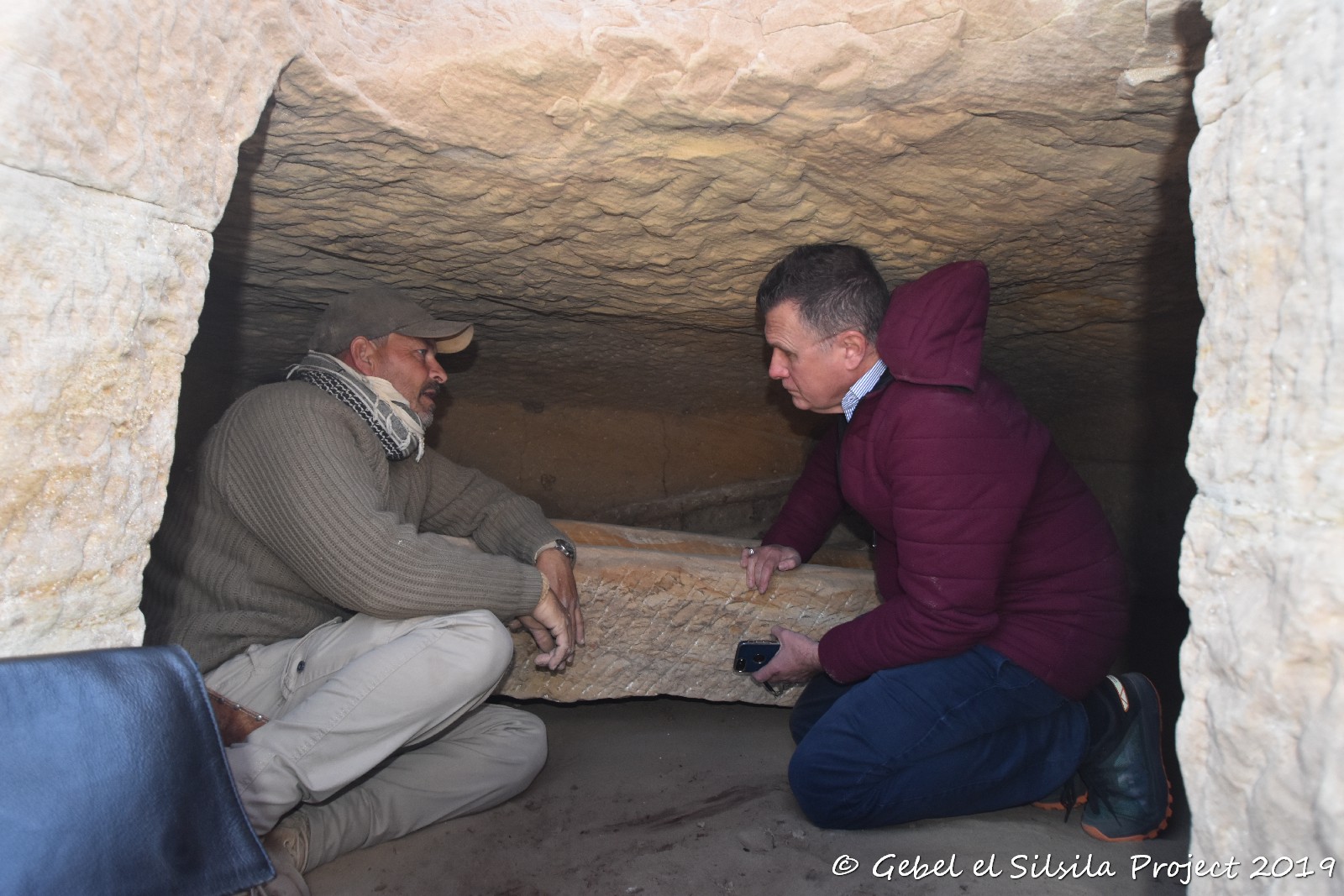
With our 10th successful season completed, there are so many things we would love to share with you. For this, there will be a series of updates within the coming months, ranging from field reports to 3D imagery, etc. For today´s update, we would like to highlight the most recent news as released by the Ministry of Antiquities this month, here in an extended (popular
scientific) report from the field.
However, firstly, and on behalf of the entire Silsila Team, we would like to thank our Egyptian colleague, Mr Ashraf Mohamed, who after having dedicated twelve years as an inspector at Gebel el-Silsila, has left us for el-Kab. We wish him all the luck and success in his new job! Thank you for the many wonderful memories, laughter and shared excitement on site, as well as for your true love for Gebel el-Silsila! Thank you Ashraf!
 |
| Ashraf Mohemd, Inspector at Gebel el-Silsila for 12 years! |
We would also like to congratulate our dear colleagues:
Mr. Nasr Salama, previous General Director of Aswan, to his retirement
Mr. Abdel Moniem, to his new position as General Director of Aswan
and
Mr. Ahmed Sayed, to his new position as Director of Kom Ombo
 |
| Funerary landscape at Gebel el-Silsila |
During their ongoing excavations, the
Swedish-Egyptian archaeological mission (Lund University), headed by Dr. Maria
Nilsson and John Ward in cooperation with the inspectorate of Kom Ombo and
Aswan directed by Mr. Abdel Menum (Aswan) and Mr. Ahmed Sayed (Kom Ombo),
discovered several intact child burials as well as crypts and chambers for
adults in the 18th Dynasty Necropolis at Gebel el-Silsila in the Aswan region.
The best-preserved child burials include:
1)
An eroded wooden sarcophagus/coffin, partially sealed with mud, containing
inhumation of a child (ST63), c. 6-9 years, oriented with head in the east,
facing north. Poorly preserved coffin, heavily eroded by annual flooding, salt,
and destroyed by beetles. The grave contained several burial goods,
including 10 ceramic items (intact beer jars, wine vessels, plates, and bowls),
bronze bracelets, a bronze razor, four scarabs attached to the child’s left
wrist, and a nefer-amulet found in the chest-area (moved from its original
location by beetles).
 |
| One of many beautiful ceramic vessels found in ST63 |
2)
A rock cut crypt (ST59) containing young child (2-3 years), wrapped in linen
and surrounded by organic material (possibly wooden coffin) destroyed by
termites, covered with poorly preserved, crumbled sandstone lid, once sealed
with plaster. Head in the south, facing west. No associated burial goods.
3)
Inhumation of a child (ST64), c. 5-8 years, oriented with head in the east,
unknown facial direction due to later disturbance of the head, possibly caused
when burying the child of ST63. Body wrapped in linen and laid on reed matting.
Burial goods included three scarabs, one of which contained the royal name of
Thutmosis II (Aa-Kheper-n-Ra), and a single ceramic vessel not in its original
location.
4)
Inhumation of child (ST69), c-5-8 years, oriented with head to the north,
facing east. Buried without any obvious care in quarried area, and covered with
quarry spoil. No immediate relation with surrounding tombs. Some indications of
sickness. Further studies required.
The child burials ST63-64 are the first of their
kind found at Gebel el Silsila, in the fact that both were preserved with
complete funerary goods. It allows an insight into both material culture as
well as funerary customs and religious beliefs, but even more so provides the
team with socio-political information and the social status of those entombed.
 |
| One of the three scarabs found around the left wrist of the child in ST64 |
 |
| Bronze bracelets found around the left wrist of the child in ST63 |
 |
| Bronze razor found above the head of child in ST63 |
The child burials also provide with a possibility
to study completely preserved inhumations, giving pathological information,
i.e. their general health and medical situation, but they are also a strong
indication of the existence and activity of complete families on site,
supporting the team’s previous hypothesis of a operative society on site in
contrast with only quarry activities. The finds bring the team one step closer
to finding the village of Kheny (ancient name of Gebel el Silsila) or what
possibly was a more local village co-existing with the larger township of Kheny.
 |
| Funerary landscape at Gebel el-Silsila |
Including the intact child burials, the team has
discovered 11 new crypts and several ‘new’ burial chambers, mainly looted
during or since antiquity. The archaeological material includes bones, ceramic
vessels, jewellery, textile, ‘plaster’, and wood.
The finds follow a line of recent discoveries made
by the team, all which date to the Thutmosid period, including 1) an usurped
relief scene in the Speos of Horemheb, showing a large ship carrying an
obelisk, comparable with the scene of Hatshepsut in Deir el-Bahari; 2) six
statues and relief scenes within shrines 30-31 from the reigns of Hatshepsut
and Thutmosis III; and 3) decoration and architectural details in limestone
from the initial building activity of the Temple of Sobek on the East Bank.
Together with the most recent discoveries in the Necropolis, all these finds
reveal the importance of Gebel el-Silsila during the Thutmosid period, blooming
with socio-political and religious activity.
Funding for this fieldwork has been provided by a
grant from the National Geographic Society (grant # HJ-103R-17), Gerda Henkel
Stiftung, the Royal Swedish Academy of Letters, History and Antiquities, Mehen and
TVAES, along with the kind and generous support of private donors. The team
would like to express their deepest gratitude to all support received, without
which none of this work could have been conducted.
 |
| Part of the 2017 Silsila Team, photo by Bob Mittelstaedt |
Background to the discovery
In 2015 the Gebel el Silsila Project reported on the discovery of a series of
tombs located in the north of Gebel el-Silsila East, in the area immediately to
the north of the famous stele of Amenhotep IV and stretching westwards to the
Nile. While the tombs had been described by a few previous visitors to the
site, no comprehensive survey, neither any proper archaeological work had been
conducted until 2015.
During the first two seasons of excavating the necropolis, 58 tombs were
identified, of which almost twenty were excavated. To this day, 69 tombs have
been identified, and a total of almost 30 have been excavated. 21 of the 69
tombs are crypts.
The tombs contain various architectural markers, including 1-2 rock-cut
chambers, external courtyards, and dressed portcullis – slot-cuts into the door
jambs by the entry to the tombs, into which a (stone-) slab would have been placed
to seal the door after burial. In addition to the chamber burials, there are
crypts cut into the rock, and niches possibly used for offering.
The majority of the tombs excavated so far – with the main exception of two
infant burials, two older children/young adults discovered and excavated during
the previous season (2016/2017) and the four child burials found this season –
have been plundered already during antiquity, and then been left neglected and
without further disturbance, and since covered by up to 3m of Nile silt, blown
in sand, and fallen quarry spoil and debris.
Some of the individual tombs reveal multiple burials within the same chamber or
crypt, possibly complete families, and individuals of varying ages and sex. In
addition, the newly discovered infant/child burials present another aspect to
the cemetery, clearly indicating family life at Gebel el-Silsila.
The archaeological material produced from the newly discovered tombs and
burials chronologically correlate with those excavated previously, so far
limited to the Thutmosid period (Thutmosis II - Amenhotep II). In addition to
the tombs themselves, the excavation has revealed finely dressed sandstone
sarcophagi, sculptured and occasionally painted pottery coffins, painted
cartonnage, textile and organic wrapping, ceramic vessels and plates, as well
as an array of jewellery, amulets and scarabs.
The vast amount of human remains so far recovered from the necropolis indicates
the individuals were generally healthy. At this time, very little
evidence of malnutrition and infection has been discovered, although exceptions
occur. Fractures of the long bones and increased muscle attachments
amongst the skeletal remains indicate behaviours related to occupational
hazards and an extremely labour-intensive environment. Furthermore, many of the
injuries appear to be in an advanced stage of healing, suggesting effective
medical care.
Some links (to be updated):
Finally, we would like to thank everyone on the
team, and wish you all Happy Holidays!