Showing posts with label Hum Lab. Show all posts

Thursday, June 22, 2017

New 3D models, Shrine 4 Gebel el-Silsila West

The Project is happy to announce that yet another two 3D-models have been uploaded to our Sketchfab page, this time focusing on Cenotaph/Shrine 4 on the West Bank. The first model shows the shrine as it is preserved today, while the second shows a digital reconstruction and interpretation of how it may have looked prior to the earthquake. 


Fractured statue group in shrine 4, photograph John Ward


3D image current preservation (here)
3D image digital reconstruction (here)
3D photography and model by Stefan Lindgren, HumLab, Lund University http://www.humlab.lu.se/en/person/StefanLindgren/

still image of the digital reconstruction by Stefan Lindgren

The monument in focus is a niche located on the southern side of ‘shrine 4’ (James and Caminos 1963, 16-18) that has been broken in three parts due to a fracture in the bedrock plausibly caused by a natural catastrophe/earthquake. The room initially measured 1.27 m deep x 1.50 m high. Three statues are seated on a bench, facing forward towards the north-facing opening/door. The three statues depict two men and a woman. While there are no preserved inscriptions or decoration, it can be presumed that the main male figure depicts a man called Djehutmose, who was a scribe of the treasury during the 18th or early 19th Dynasty (based on an adjacent, plausibly associated hieroglyphic text) (James and Caminos 1963, 16). 

Shrine 4, Gebel el-Silsila West, photograph by John Ward
This shrine, together with 31 more, are currently re-documented and prepared for a new and updated publication, which will include not only the original epigraphy, but also later graffiti, architectural components, and state of preservation by the current archaeological project on site. By means of newer, digital equipment and software, painted details faded to the naked eye, become visible and bring more information in terms of each shrine’s original decoration (see some examples attached herein).

original photo from the ceiling in shrine 4, photograph by Maria Nilsson

D-Streched image emphasizing certain colours

Original photo of one of the statues in shrine 4, photograph by Maria Nilsson

Image in DStrech revealing original colour

Original photo of painted and etched graffiti in Shrine 4, photograph by Maria Nilsson

Details in DStrech


Link to DStrech software here 


Monday, May 25, 2015

Cenotaphs go 3D!

overview of the west bank with its 32 shrines

Other than the traditional Egyptologist, who per automatic knows the basics about Gebel el Silsila’s characteristic cenotaphs, anyone who has had the pleasure of sailing the magnificent River Nile could gaze upon these glorious shrines that lay scattered along the west bank to the south of the famous rock-cut temple and ends just north of the capstone. These cenotaphs – ‘false/empty tombs’ – were the object of extensive study by T. G. H. James and R. A. Caminos during an epigraphic survey conducted on behalf of the EES (Egypt Exploration Society) during the last century. James and Caminos published the shrines’ original epigraphy and iconography (hieroglyphic text and illustrations) and short comments on their layouts and style (James, T. G. H. and Caminos, R. A., Gebel es-Silsilah, vol. I: the shrines, London 1963). Since then, A. Kucharek has continued the study in her Master thesis Die Felskapellen der 18. Dynastie in Gebel es-Silsilah, followed by the article ‘Senenmut in Gebel es-Silsilah’ (MDAIK 66, 2010, 413-160).

photo by Scotty Roberts


Still, however, there are many aspects of these 32 shrines that await further study, including later additions (graffiti, quarry activity, reuse, etc.), for which we, as the current archaeological team, have taken on the task to re-document them. As part of this re-documentation more effort is placed on the monuments themselves, and making them available for the larger public also outside the academic world.

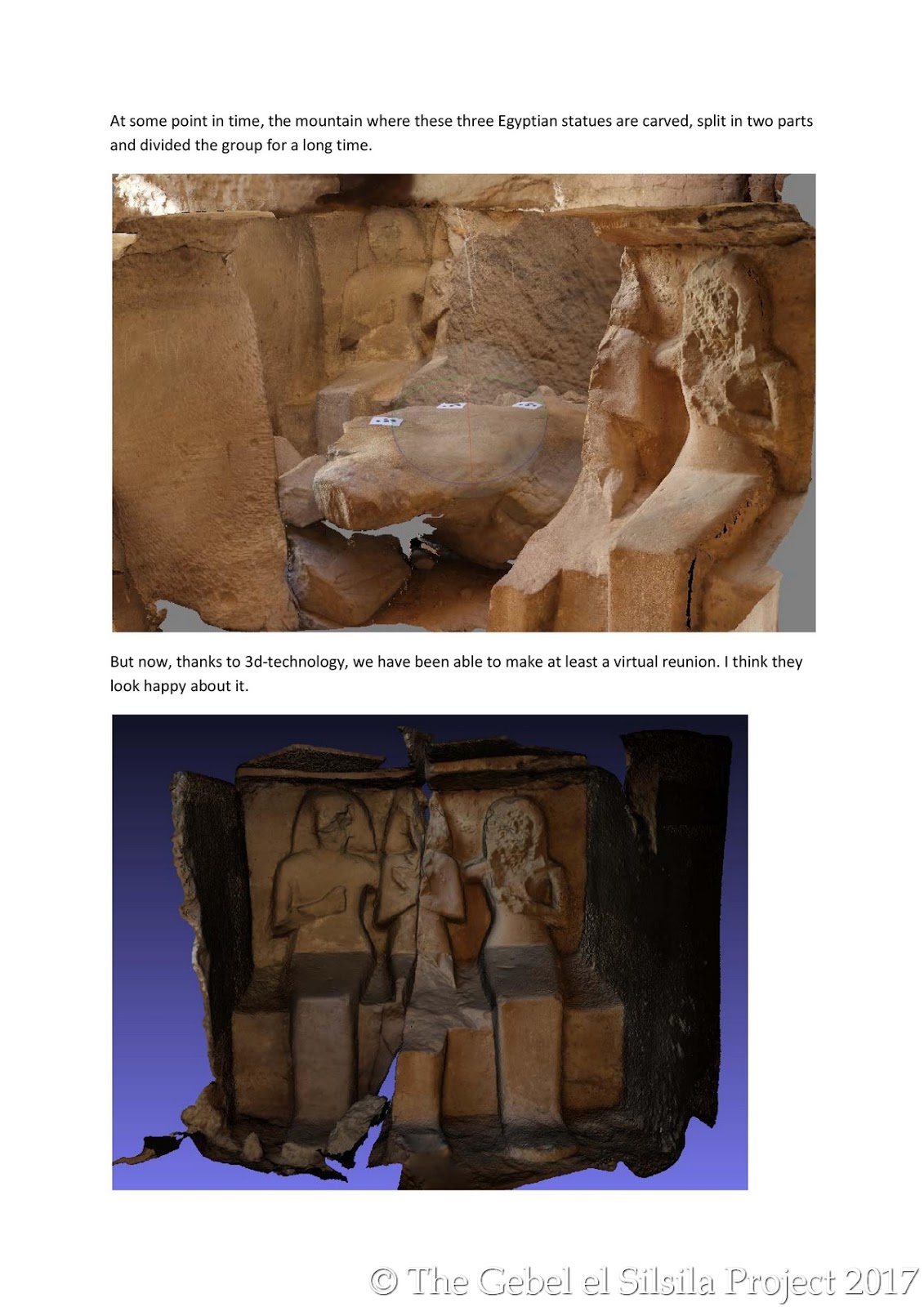
As such, we incorporate up-to-date digital technology in our work, such as 3D imaging/photogrammetry, which not only provides us with the most extraordinary ‘movable’ objects, but also the possibility to put fragmented/broken items back again without having to even touch the monument itself. As an example, we would like to share with you a preliminary reconstruction of three broken statues of shrine no. 4 (James and Caminos 1963, 16-18):  


shrine 4


The scanned monument is a room located on the southern side of shrine 4, with three statues that have been broken in three parts due to a fracture in the bedrock, plausibly caused by a natural catastrophe. The room initially measured 1.27 m deep x 1.50 m high. Three statues are seated on a bench, facing forward towards the northern-facing opening/door. The three figures depict two men (left/east and centre) and one woman (right/west). While there are no preserved inscriptions or decoration, it can be presumed that the main male figure depicts a man called Djehutmose, who was a scribe of the treasury during the 18th or early 19th Dynasty (based on an adjacent, plausibly associated hieroglyphic text) (James and Caminos 1963, 16). With the words of Stefan Lindgren, our 3D recorder from the Humanities Laboratory at Lund University: “At some point in time, the mountain where these three statues are carved, split in two parts and divided the group for a long time. But now, thanks to 3d-technology, we have been able to make at least a virtual reunion. I think they look happy about it.”


The southern group of statues

3D recorder Stefan Lindgren busy photographing an early Roman graffiti-panel


For those of you who want to ‘play around’ with the 3D image of the statues, you can find the movable object here, and below is a 'still' demonstration:


Wednesday, December 03, 2014

Digital recording of and at Gebel el Silsila

One and a half year ago I was contacted by Maria who told me about Silsila and the projects that is running there. She asked me if I was interested in joining them and thereby bringing in the technology we are working with in the Humanities Laboratory at Lund University where I am working as a research engineer. This technology is focused on 3d data and we mainly apply it on archaeological research where we help to develop methods of using it in smart ways and incorporating it into the archaeological workflow. For that reason we are always interested in case studies, so Marias initial mail excited me. After a lot of planning, I and my colleague Giacomo Landeschi finally had the opportunity to visit the site and make a first study of it to find out if it is a site that would fit our line of research.

First fixed point established

The warmth that met us, not only temperature wise (having left a very cold Sweden behind us), but also from the very nice members of the team on site was a very good start. And I must say it only got better as the days passed. Gebel el Silsila is a really fascinating site and most of our techniques and methods could easily be used there. But for this first visit we decided only to bring a differential gps, since careful mapping of the site of course is a priority. During the week we managed to set up a number of fixed points to be used in the future either with the gps or a total station. We also mapped the perimeter of the main quarry and some other interesting details spread over some parts of the area. During the coming weeks we will post process the data and set up a basic 3d-GIS system that can be built on in the coming seasons.

Giacomo records a point at the top of the main quarry

We also work quite a lot with 3d-models in our lab and one technique for this that we used during the week is called structure from motion, in which a big amount of ordinary 2d photos is taken from a lot of different angels of an object and then processed in special software to create a 3d-model. You can see one such example here, where a 3d-model was made of a sphinx that is close to one of the quarries on the east side. It might take some time to load since it is rather big, even though its resolution is reduced quit a lot from the original 3d-model.
Since it is possible to move around the light source in most 3d visualizations systems, this technique also is good to apply to rock carvings or quarry marks. When the light hits the model of these from different angels, features in the carving can be more pronounced. One example of that is here (to move the light click on the light bulb to the left and then move the mouse over the model with the left mouse button pressed).

Photos been taken to make a 3d-model.


Silsila is definitely a site where we will like to do more work. We will be back next season and I already look forward to meeting Madame Silsila and also the wonderful team there again. I would like to thank Maria and John for their hospitality and generosity.

Stefan Lindgren