Showing posts with label quarry. Show all posts

Sunday, December 30, 2018

THANK YOU!


Dear all,

Prior to this, our Season 12, we put in process a massive Kickstarter campaign targeting work in the Temple of Sobek on the East Bank of Silsila. We were overwhelmed as we reached our goal and thereby secured the continuation of work at this particular site. As part of this campaign, our backers were able to choose between various rewards, of which one was an official thank you here on our blog. After receiving our backers’ approval, the time has now come for us to publically thank each one of you who made this work possible! Please find the list of backers, arranged alphabetically, below (including some whom wished to remain anonymous).

Image of the western structure from last season

So, what are the results thus far? Well, one of the main achievements is that we have physically connected the Main Temple with the Western Structure by removing, sifting, and analysing the massive mound of silt, soil and archaeological remains known to the team as “Temple Mound”. We are incredibly grateful to our dedicated Egyptian workers for being patient, understanding and willing to continue the daily battle against this mound, including its modern hard spoil left from the building of the adjacent modern canal. Without our workers aid, we would not have been able to reach such great results in one season!

connecting the structures, here showing a part of the mound still in situ

Workers taking on the Mound during the previous season. Photo by Anders Andersson

Connecting the structures - in progress. Photo by Anders Andersson

Excavations of the western structure have so far focused on its central part, in which a circular rock-cut structure was revealed, and thus far reaches some 5-6 m below the ground. Work is still ongoing, and has now changed from sand and soil archaeology to excavations of wet mud as a pump is required to remove the ground water from therein.

View of the western structure, including its circular centre

What may there be?

3D model of work progress. Photogrammetry by John Ward

Connecting the two structures and excavating the circular structure has resulted in a large amount of fragments from the once magnificent Temple of Sobek. With over 500 sandstone fragments, nearly 200 limestone details, various small finds (including evidence that links Silsila with Roman Gaul!), and thousands of ceramic sherds, we consider the work in the temple a great success. However, we are not finished yet! Work will continue until the end of our season, after which we hope to begin putting together a beautiful book on Sobek as promised our backers of the campaign.
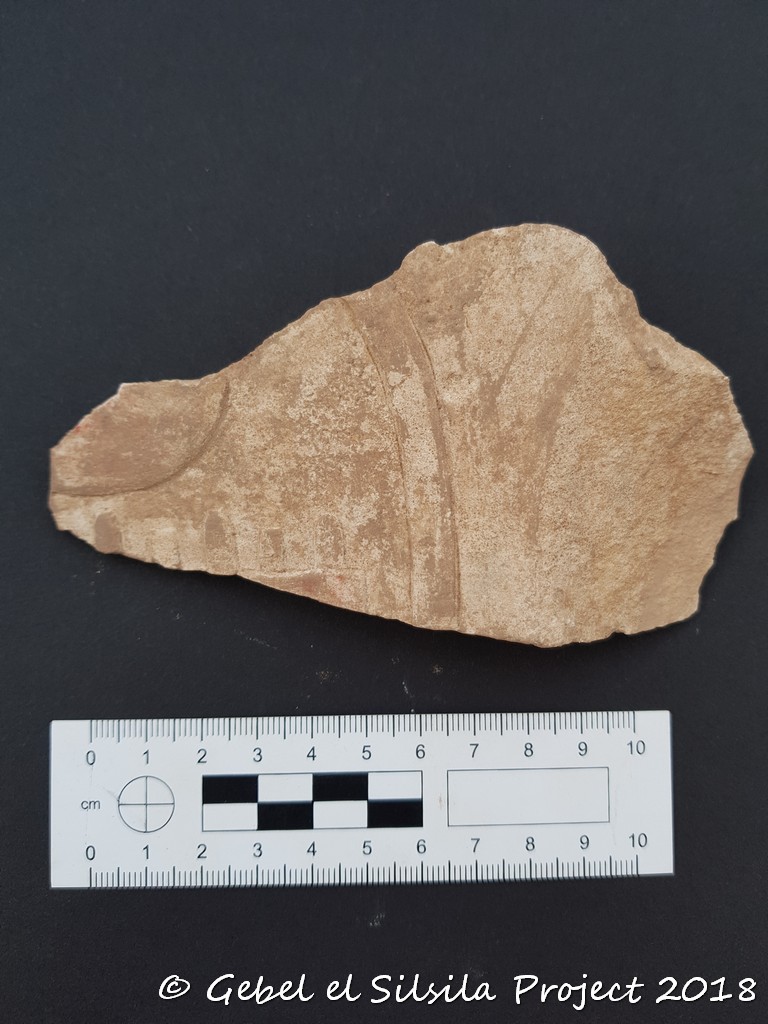
Limestone detail revealing a part of Men-Kheper-Re, i.e. Thutmosis III

Limestone detail of the little rower man, a glyph that forms the first sign in the ancient name of Silsila: "Kheny"!

If YOU would like to sponsor the project, helping us reveal more information about the Temple of Sobek – or the newly discovered subterranean shaft tomb, aid us with funds to employ more workers, buy a new pump or other important equipment, please support us by donating on our Friends of Silsila webpage!

Finally, with this short update, we would like to thank you all for your support and encouragement, and to wish you all the best for a Happy, Prosperous, Healthy and Adventurous New Year 2019!

___________________________________________________________________________

THANK YOU for your support in “Finding Sobek”


Elisabeth Ahlsen
Jane Akshar
Jens Allwood
Anders Andersson
Tove Andersson
Pierre Arnold III
Paul Bagheri-Poubanne
Annelise Baer
Mary Banks
Elaine Barke
Lida Barmala
Shannon Beltz
Shelby Beltz
Karin Berggren
Nils & Anna Carin Billing
Erin Bisson
Susanna Blåndman
Ann Brun
John Burn
Jeff Burzacott
Yvonne Buskens-Frenken
Etta Chatterjee
Mats Cullhed
Lynn Couture
Annica Dahlström
Katie Davenport-Mackey
Sharon Davidson
Darryl Dobson
Jennifer Dyer
Rudi Endresen
Françoise Entelis
Raphael Epand
Nils Essle
Isabella Faroppa
Raquel Agrás Flores
Melanie Friederichs
Yishay Gabrieli
Linda Garza Hansen
Bronwyn and Peter Harrison
Carole Gillis
Richard Grant
Sven Grimm
Tiffany Hall
Diane Hanger
Beverley Haystead
Debra Hayward
Andy Hicks
Brenda Hill
Kristoffer Holmén
Sofia Häggman
Inger Jakobsson
Tony Jibbefors
Dr. Kim A Jobst DM FRCP MFHom
Sasha K (Sobekemiti)
Sölve Kajanus
Maria Karlman Noleryd
Allan King
Josa Kärre
Matthew King
Lena Kristensson
Niklas Kärrman
Anna Lagaron
Lars Larsson
Stephen Lazenby
Susan Lea
Marie Lebeau
Petra Lether
Tom Lesniewski
Jeszika Le Vye
Emma Libonati
Ulrika Lindblom-Nilsson
Stephanie Lindeburg
Anna Lindqvist
Ted Loukes
Andrea Lundberg Blank
Dan Madsen
Elisabeth Maubert
Beatrice Mackenzie
Flore Mayvial
Chandler McGowan
Denise McGrath
MEHEN
Françoise Meyer
James Miller
Kyra van der Moezel
Glyn Morris
Krista Moyls
Charlie Nilsson
Fredrik Nilsson
Gunhild Nilsson
Johan Nilsson
Lill Nilsson
Maria Nilsson
Svante Nilsson
Miss Leanne Northrop
Hans Nyman
Ingemar Nyman
Jennifer OConnell
Helen Ollett-Nash
Eva Oredsson
Kim Nelson & Jackson Ovadia
Vincenzo Pannone
Patrick Patzer
Leena Pekkalainen
Jenny Persson
Julie Phillips
Alban-Brice Pimpaud
Carolyn Prior
Berit Prohaszka
Johanna Rex
Sue Retzer
Britnee Ricks
Carlo Rindi Nuzzolo
Abby and Bryn Roberts
Peter Robinson
Richard Rossi
Vincenzo Salvatore Pannone
Benita Schreuder
Sebastian
Astrid Segmar
Brian & Pam Silverian
Robert Skinner
Amanda Slack
Mrs Julie Smith
Martin Smith
Michele Stopera Freyhauf
Rocci Stucci
Pia Svanbom
Sofia Svensson
Kevin Swanson
Robert and Olivia Temple
Karen Thomas
Jen Thum
Debbie Tily
Ian Tompkins
Dr. CMCl Toporow
Paula Tutty
Margareta Törngren
Vanellus Trust
Juliane Unger
Julie Villaeys
John Ward
Charlotte Weaver
Judith Weingarten
Tobias Werner
Gertie Werner-Bäumer
James Whitfield
George Wood
Robin Young
Renée Zetterlund

Lihi Zilverberg

If you are a backer and connot find your name on the above list, please send us a quick email and we will update the page! 

Thursday, June 29, 2017

3D Inner sanctuary of the speos

For those of you who enjoy the 3D models, you will be delighted to find yet another two examples uploaded, showing the northern and southern walls of the inner sanctuary of the speos at Gebel el-Silsila.

view of the inner sanctuary and the main gods of the speos. Photo by Maria Nilsson


The long south wall of the sanctuary is decorated in sunken relief, showing almost 40 seated deities uttering wishes of well being for King Horemheb. They have been often described as an Egyptian pantheon. Turned, however, towards the end wall of the temple, they are here depicted as guests to witness a mythological mystery taking place. Smaller vignettes showing priests adoring gods were later added in an empty lower portion of the wall during the Ramesside period. The destructions visible at the left are traces of eradication or hacking done during the end of the Amarna period. They were concealed under a coating of hard 'plaster' when the wall was restored for new inscriptions.

South wall of the inner sanctuary, photo by Maria Nilsson

The northern wall offers an interesting parallel to the southern wall, It shows another 'pantheon', in fact a group of invited divinities, but standing in two registers and sculptured in true relief. The relief includes 23 figures mixing gods and goddesses. If the destructions are rather related to unfortunate modern looting attempts, some traces of ancient erasures related to the Amarna period can still be seen. The Ramesside presence is this time limited to one line of text added to the right in the lower empty space. However, a viewer with keen eyes for painted and very faded graffiti will find several traces of such too.
North wall of the inner sanctuary, photo by Maria Nilsson

Gebel el Silsila Project - Epigraphic Survey
3D Photography, modelling and anotations by Philippe Martinez, lead epigrapher for the project, CNRS, Sorbonne Universités: philippe.martinez@upmc.fr

Digital images created with plexus software by Kevin Cain (plexus-3d.com), kevin@insightdigital.org


Wednesday, June 28, 2017

3D Ramesside Royal Stelae West Bank

More amazing 3D models from Gebel el-Silsila, now showing the three royal stelae on the west bank.


The main model shows an overview of the three stelea, which are situated along the cenotaph road on the west bank of the Nile. They have been preserved between two quarried surfaces. They were erected, from south to north - or left to right - by Ramses III, Sheshonq I and Ramses IV respectively. They clearly have been the subject of a local cult and below them are to be seen the traces of the Nile flood that reached their foot annually at the beginning of the summer.


There are also individual models of the three stelae:


and 

Gebel el Silsila Project - Epigraphic Survey
Photography, modelling and anotations by Philippe Martinez, lead epigrapher of the project, CNRS, Sorbonne Universités: philippe.martinez@upmc.fr

Digital models created with plexus software by Kevin Cain (plexus-3d.com), kevin@insightdigital.org

New models from the Speos

The Silsila Team is happy to announce yet some more 3D models from within the Speos or Rock-cut temple of the west bank.

The two models show the Northern and Southern side of the Eastern wall of the sancturary, divided by the doorway.

The Northern side shows divinities related to the control of the Nile Flood and connected to Aswan and the first cataract, as well as the local site of Kheny (Silsila). It is interestingly carved in relief for the upper part and in sunken relief for the lower.

The Southern side shows divinities related to the control of the Nile Flood, this time the Osirian family connected to Abydos in Middle Egypt, but also with Nubia and the South where the Nile flood came from.

Dr Martinez in the speos


Photography, modeling and anotations by Philippe Martinez, CNRS, Sorbonne Universités, Lead Epigrapher for the Silsila Project: philippe.martinez@upmc.fr

Digital models created with plexus software by Kevin Cain (plexus-3d.com), kevin@insightdigital.org

Thursday, June 22, 2017

New 3D models, Shrine 4 Gebel el-Silsila West

The Project is happy to announce that yet another two 3D-models have been uploaded to our Sketchfab page, this time focusing on Cenotaph/Shrine 4 on the West Bank. The first model shows the shrine as it is preserved today, while the second shows a digital reconstruction and interpretation of how it may have looked prior to the earthquake. 


Fractured statue group in shrine 4, photograph John Ward


3D image current preservation (here)
3D image digital reconstruction (here)
3D photography and model by Stefan Lindgren, HumLab, Lund University http://www.humlab.lu.se/en/person/StefanLindgren/

still image of the digital reconstruction by Stefan Lindgren

The monument in focus is a niche located on the southern side of ‘shrine 4’ (James and Caminos 1963, 16-18) that has been broken in three parts due to a fracture in the bedrock plausibly caused by a natural catastrophe/earthquake. The room initially measured 1.27 m deep x 1.50 m high. Three statues are seated on a bench, facing forward towards the north-facing opening/door. The three statues depict two men and a woman. While there are no preserved inscriptions or decoration, it can be presumed that the main male figure depicts a man called Djehutmose, who was a scribe of the treasury during the 18th or early 19th Dynasty (based on an adjacent, plausibly associated hieroglyphic text) (James and Caminos 1963, 16). 

Shrine 4, Gebel el-Silsila West, photograph by John Ward
This shrine, together with 31 more, are currently re-documented and prepared for a new and updated publication, which will include not only the original epigraphy, but also later graffiti, architectural components, and state of preservation by the current archaeological project on site. By means of newer, digital equipment and software, painted details faded to the naked eye, become visible and bring more information in terms of each shrine’s original decoration (see some examples attached herein).

original photo from the ceiling in shrine 4, photograph by Maria Nilsson

D-Streched image emphasizing certain colours

Original photo of one of the statues in shrine 4, photograph by Maria Nilsson

Image in DStrech revealing original colour

Original photo of painted and etched graffiti in Shrine 4, photograph by Maria Nilsson

Details in DStrech


Link to DStrech software here 


Friday, November 25, 2016

Searching for knowledge by uncovering the past

The following post was written by one of the project's wonderful supporters; his and his family's encouragement and genuine support inspired us to share his words here.

The original 'opinion piece' was published by Samuel Strait on November 19, 2016 at http://www.crescentcitytimes.com 


Searching for knowledge by uncovering the past

– So often as we enter the holiday season we are inundated with requests for some form of charity from groups near and far.  Very often we are hesitant, not knowing exactly how that donation is to be spent and whether or not “good works” will come of our donation.  It is a luxury then to be able to donate to those nearer to home and witness first hand those good works.

For those that have broader horizons in their wish to donate to good works, there is a long list of groups of people doing things in the far corners of this world that further our knowledge of the progress of mankind throughout history.  To those that are interested, money can be donated to support such good works all over the world.  Many are reputable and connected to University’s and College’s which send researchers far and wide to scour the planet in search of knowledge which can make the world a better place.  Often these groups are underfunded and in constant need for donations which will aid them in the quest for knowledge.

For the past eight seasons, this group has gathered on this site to preserve and learn from the discoveries made.  During this particular season, I have the privilege of being related to one of the members of this group who has given her time to further the rewards gained from learning about the past at this particular archaeologic site.  Because Egyptology in this area has not the claim to fame that site’s in and around Cairo, the three Great pyramids, the Sphinx, or even the temple complex at Abu Simbel, money to fund the season’s digs must come from the charity of people who wish to contribute to a very worthwhile cause that so often goes unrecognized and overlooked.

What is unique about this particular group is that they will continue to do good work with whatever comes to them and are grateful for any small amount people wish to contribute.  They, the Directors, Maria Nilsson and John Ward, keep donors up to date on progress made at the site as well as acknowledging each donation with a personal message.  For those that wish to donate, they have a web page, friendsofsilsila.com, or if you just want to live vicariously through their blogspot, it can be found at gebelelsilsilaepigraphicsurveyproject.blogspot.com.  This is a unique opportunity for those that wish to make a donation in a non traditional way, and know that you are contributing to the knowledge of the world and a very good cause.  And, yes, my wife and I have made a small contribution, feel better for it and feel more like citizens of the world, many of which visit our small corner of the world.

_________________________________________________________________________________

Thank you dear Samuel and to your entire family, and all amazing people who continues to show their support and encouragement! The Gebel el Silsila Project is deeply thankful and forever grateful!

some of this year's team members, including some of our amazing workers!
Donations to the Gebel el Silsila Project goes directly towards employing more workers, which allows the team to discover more monuments and tombs in the Necropolis, and study more ground breaking information about the ancient past at Gebel el Silsila!

Wednesday, March 30, 2016

The New Kingdom Necropolis of Gebel el Silsila

As you may have noticed there has been no news from the field since the beginning of our spring season back in January. Indeed there were enormous amounts of historical and archaeological details to share with you all, but time slipped away from us combined with the demanding work related to our latest announced discovery - the Necropolis.

Obviously, we have been aware of the Necropolis' existence before, and it is certainly not a discovery that anyone will simply "stumble on". Instead it was a well structured plan, which was based on the increasing environmental threat to some of the tombs (rising ground water with highly destructive salt contents), combined with a larger team on site that enabled us to get started. Please see below for our (very) preliminary report on the tombs.


3400 year old necropolis discovered at Gebel el Silsila
Dr. Maria Nilsson and John Ward

During the spring season 2016 the Swedish archaeological mission at Gebel el Silsila, led by Dr. Maria Nilsson and John Ward, in co-operation with the MSA, as well as Kom Ombo and Aswan Inspectorates under General Directors Abd el Menum and Nasr Salama respectively, discovered a remarkable New Kingdom necropolis with archaeological material dating from the early 18th dynasty and indications of re-use throughout the 19th dynasty. 

So far, over 40 tombs have been documented, including a small shrine, many of which have suffered from heavy erosion and extreme decay due to the rising water table and its high salt contents. As part of exploring the best method to save the monuments, the team undertook the careful cleaning of a small selection of tombs, work that will continue during forthcoming seasons.

The tombs consist of one to two undecorated rock-cut chambers, with one or more crypts cut into the bed rock floors, some preserved with remains of their original lid. The entrance of the tombs consist of a squared semi-dressed aperture that incorporate a vertical slot to either door jamb that would have facilitated a portcullis type of closure. The tombs are generally accessed via a series of steps that descend into a rough-cut squared chamber. Due to the lack of exterior or interior decoration, the identity of the persons buried remains unknown at this time.

The general archaeology and the stratigraphy of the tombs suggest that they were plundered already during antiquity, and again during the 19th century, as well as affected by the annual floods and driven sand, resulting in disturbed layers containing foremost pottery, bones, some beads and Nile silt, mixed with animal remains including crocodile scutes. Similar composition of archaeology was documented outside the tombs.

The ceramic material has been identified by the team's ceramic expert, Dr. Sarah Doherty, as traditional New Kingdom funerary ware, including storage vessels, beer jugs, and a selection of votive vessels. Preliminary analysis of the bones, made by Prof. Salima Ikram, suggests burials of men, women and children of all ages. Importantly, this indicates a more permanent habitation at Gebel el Silsila than previously thought.

Among the more important findings was a reversible seal ring, which depicts the cartouche of Pharaoh Thuthmosis III “Men-kheper-re” (comparable with seal UC61144: http://www.ucl.ac.uk/museums-static/digitalegypt/seals/archive/uc61144.jpg), and a scarab also bearing the pharaoh’s name. Associated text on the seal's reverse is currently studied by the team's Egyptologists. 

Fragments of detailed, painted mud-plaster indicate decorated coffins, which together with fragments of mummy wrapping and various beads and amulets suggest individuals of considerable status.

The shrine that was included among the discoveries is a small rock-cut sanctuary located on the banks of the Nile. It consists of two open chambers facing the river (west), which partially retain architectural features, including dressed walls and an inner doorway crowned with the winged solar disc. Further analysis is required of its archaeology due to annual flooding and extensive tumble since antiquity.

____________________________________________________________________________

The latest discovery as well as the season's work (with more news to come...!) was made possible by financial support from various foundations, including:

Magnus Bergvalls Stiftelse
National Geographic Grant
Enboms Stiftelse 
Helge Ax:son Johnsons stiftelse
Gerda Henkel Stiftung

and none of the work could have been completed without the most fabulous team ever! Thank you all for sharing the moments (hard work, blood, sweat and tears lol) and being part of this incredible journey that we are on!

Also, and with uppermost respect, thank you to the general inspectorates of Kom Ombo and Aswan, to General Directors Nasr Salama and Abd el Menum, and all the great inspectors of Kom Ombo and general inspectors of Gebel el Silsila, as each and everyone of you actively participate in changing history!

Maria and John 

Tomb 15 exterior

crypt with partially preserved lid inside Tomb 15

Tomb 14 interior, including entrance to second chamber

Doorway to Tomb 14, interior

Tomb 2, exterior

Seal: cartouche of Thutmosis III (Men-Kheper-Re)

Scarab with the cartouche of Thutmosis III

Portculis of Tomb 2, exterior

One of the crypts of  Tomb 14

Crocodile scutes

Bone fragment in mixed layer in Tomb 2

Steps inside Tomb 14

Shrine with winged solar disc and pillars on respective side