|
| overview of the west bank with its 32 shrines |
Other than the traditional Egyptologist, who per automatic knows
the basics about Gebel el Silsila’s characteristic cenotaphs, anyone who has
had the pleasure of sailing the magnificent River Nile could gaze upon these glorious
shrines that lay scattered along the west bank to the south of the famous
rock-cut temple and ends just north of the capstone. These cenotaphs – ‘false/empty
tombs’ – were the object of extensive study by T. G. H. James and R. A. Caminos
during an epigraphic survey conducted on behalf of the EES (Egypt Exploration
Society) during the last century. James and Caminos published the shrines’
original epigraphy and iconography (hieroglyphic text and illustrations) and
short comments on their layouts and style (James, T. G. H. and Caminos, R. A.,
Gebel es-Silsilah, vol. I: the shrines, London 1963). Since then, A. Kucharek
has continued the study in her Master thesis Die Felskapellen der 18. Dynastie in Gebel es-Silsilah, followed by
the article ‘Senenmut in Gebel es-Silsilah’ (MDAIK 66, 2010, 413-160).
 |
| photo by Scotty Roberts |
Still, however, there are many aspects of these 32 shrines
that await further study, including later additions (graffiti, quarry activity,
reuse, etc.), for which we, as the current archaeological team, have taken on
the task to re-document them. As part of this re-documentation more effort is
placed on the monuments themselves, and making them available for the larger public
also outside the academic world.
As such, we incorporate up-to-date digital technology in our
work, such as 3D imaging/photogrammetry, which not only provides us with the
most extraordinary ‘movable’ objects, but also the possibility to put
fragmented/broken items back again without having to even touch the monument
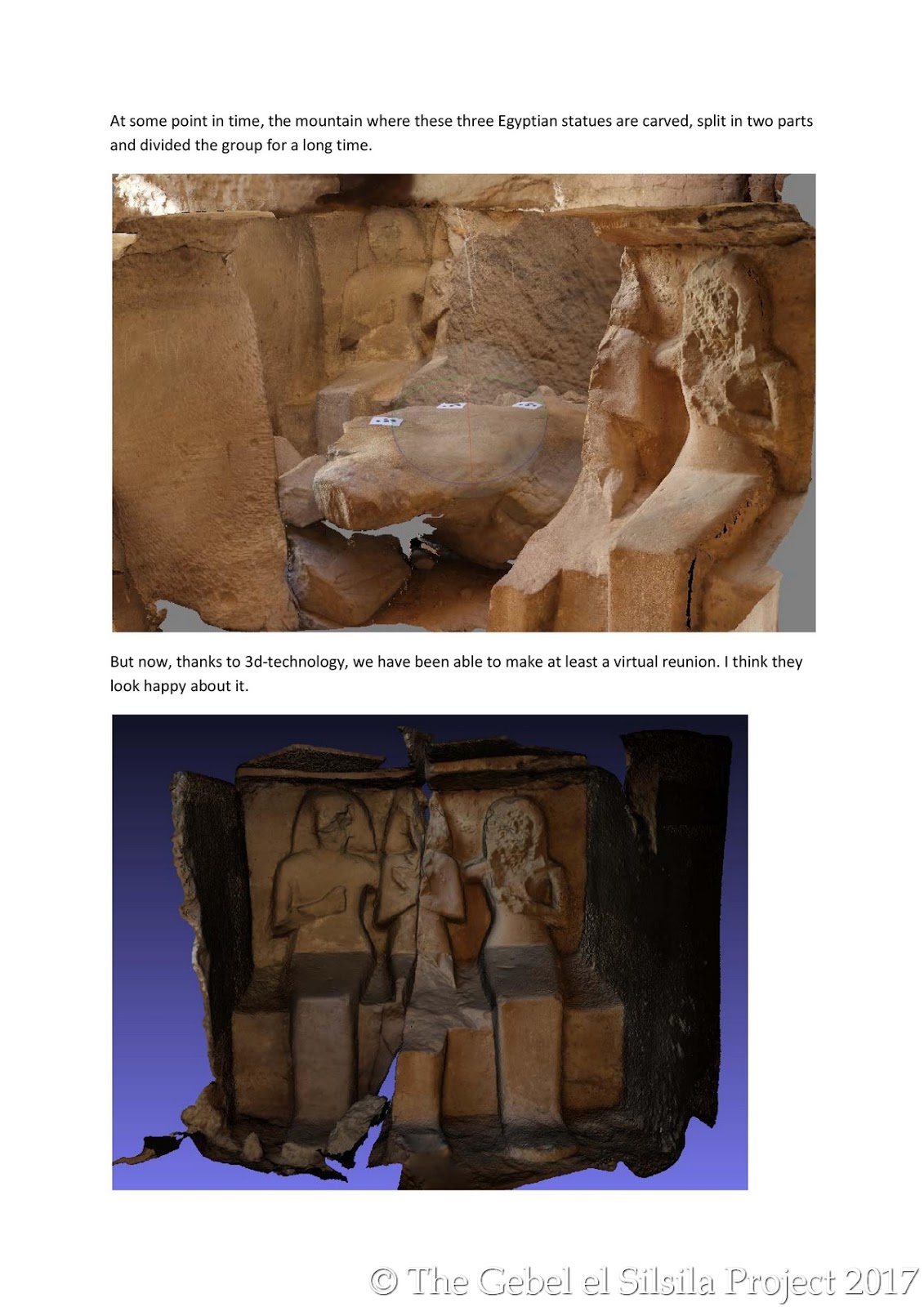
itself. As an example, we would like to share with you a preliminary
reconstruction of three broken statues of shrine no. 4 (James and Caminos 1963,
16-18):
 |
| shrine 4 |
The scanned monument is a room located on the southern side
of shrine 4, with three statues that have been broken in three parts due to a
fracture in the bedrock, plausibly caused by a natural catastrophe. The room
initially measured 1.27 m deep x 1.50 m high. Three statues are seated on a
bench, facing forward towards the northern-facing opening/door. The three
figures depict two men (left/east and centre) and one woman (right/west). While
there are no preserved inscriptions or decoration, it can be presumed that the
main male figure depicts a man called Djehutmose, who was a scribe of the treasury
during the 18th or early 19th Dynasty (based on an
adjacent, plausibly associated hieroglyphic text) (James and Caminos 1963, 16).
With the words of Stefan Lindgren, our 3D recorder from the Humanities
Laboratory at Lund University: “At some point in time, the mountain where these
three statues are carved, split in two parts and divided the group for a long
time. But now, thanks to 3d-technology, we have been able to make at least a virtual
reunion. I think they look happy about it.”
 |
| The southern group of statues |
 |
| 3D recorder Stefan Lindgren busy photographing an early Roman graffiti-panel |
For those of you who want to ‘play around’ with the 3D image
of the statues, you can find the movable object
here, and below is a 'still' demonstration: