Showing posts with label Stefan Lindgren. Show all posts

Thursday, June 22, 2017

New 3D models, Shrine 4 Gebel el-Silsila West

The Project is happy to announce that yet another two 3D-models have been uploaded to our Sketchfab page, this time focusing on Cenotaph/Shrine 4 on the West Bank. The first model shows the shrine as it is preserved today, while the second shows a digital reconstruction and interpretation of how it may have looked prior to the earthquake. 


Fractured statue group in shrine 4, photograph John Ward


3D image current preservation (here)
3D image digital reconstruction (here)
3D photography and model by Stefan Lindgren, HumLab, Lund University http://www.humlab.lu.se/en/person/StefanLindgren/

still image of the digital reconstruction by Stefan Lindgren

The monument in focus is a niche located on the southern side of ‘shrine 4’ (James and Caminos 1963, 16-18) that has been broken in three parts due to a fracture in the bedrock plausibly caused by a natural catastrophe/earthquake. The room initially measured 1.27 m deep x 1.50 m high. Three statues are seated on a bench, facing forward towards the north-facing opening/door. The three statues depict two men and a woman. While there are no preserved inscriptions or decoration, it can be presumed that the main male figure depicts a man called Djehutmose, who was a scribe of the treasury during the 18th or early 19th Dynasty (based on an adjacent, plausibly associated hieroglyphic text) (James and Caminos 1963, 16). 

Shrine 4, Gebel el-Silsila West, photograph by John Ward
This shrine, together with 31 more, are currently re-documented and prepared for a new and updated publication, which will include not only the original epigraphy, but also later graffiti, architectural components, and state of preservation by the current archaeological project on site. By means of newer, digital equipment and software, painted details faded to the naked eye, become visible and bring more information in terms of each shrine’s original decoration (see some examples attached herein).

original photo from the ceiling in shrine 4, photograph by Maria Nilsson

D-Streched image emphasizing certain colours

Original photo of one of the statues in shrine 4, photograph by Maria Nilsson

Image in DStrech revealing original colour

Original photo of painted and etched graffiti in Shrine 4, photograph by Maria Nilsson

Details in DStrech


Link to DStrech software here 


Monday, June 19, 2017

Silsila 3D images on Sketchfab!

Dear all,
the Gebel el Silsila Team is delighted to share with you some exciting new 3D-images viewable on Sketchfab.com.

The two published models mark the beginning of a new step in the project, aiming to share with the greater audience and our wonderful, supportive followers some of the unique reproductions of various (published) monuments on site.

We hope you will enjoy as much as we do!

Model 1: Scene of Goddess Taweret suckles the king, Gebel el Silsila West Bank

The relief is situated in the rock-cut temple dating to the 18th Dynasty, and more precisely to the time of Tutankhamun/Horemheb (around 1330 BC). It shows the king as a young boy, suckling the local goddess Taweret (often shown as a hippopotamus, but here as an elegant woman), witnessed by his godly protectors Amun, King of the Gods,  Khnum, god of birth, and Sobek, the local crocodile god and companion of Taweret. Through the divine milk, the king becomes superhuman and thus has the power necessary to interact with the gods and the sacred. This ritual seems to have been part of the crowning ceremonies.

overview of the southern scene, photo: Maria Nilsson


Model 2: Horemheb presenting offerings to Amun-Ra and Mut

This relief is located in the short passage between the main hall and the sanctuary, on the northern wall of the passage, in the rock-cut temple of the West Bank. It shows King Horemheb making an offering to the Theban gods, Amun-Ra and Mut. The figures and texts are sculptured in sunken relief, usually applied for outside decoration, but then everywhere after the Amarna period.

king offering to Amun-Ra and Mut, photo: Maria Nilsson


3D Photography, Modeling and anotations: Philippe Martinez, CNRS, Sorbonne Universités, philippe.martinez@upmc.fr

Digital models created with plexus, software by Kevin Cain (plexus-3d.com), kevin@insightdigital.org

Monday, May 25, 2015

Cenotaphs go 3D!

overview of the west bank with its 32 shrines

Other than the traditional Egyptologist, who per automatic knows the basics about Gebel el Silsila’s characteristic cenotaphs, anyone who has had the pleasure of sailing the magnificent River Nile could gaze upon these glorious shrines that lay scattered along the west bank to the south of the famous rock-cut temple and ends just north of the capstone. These cenotaphs – ‘false/empty tombs’ – were the object of extensive study by T. G. H. James and R. A. Caminos during an epigraphic survey conducted on behalf of the EES (Egypt Exploration Society) during the last century. James and Caminos published the shrines’ original epigraphy and iconography (hieroglyphic text and illustrations) and short comments on their layouts and style (James, T. G. H. and Caminos, R. A., Gebel es-Silsilah, vol. I: the shrines, London 1963). Since then, A. Kucharek has continued the study in her Master thesis Die Felskapellen der 18. Dynastie in Gebel es-Silsilah, followed by the article ‘Senenmut in Gebel es-Silsilah’ (MDAIK 66, 2010, 413-160).

photo by Scotty Roberts


Still, however, there are many aspects of these 32 shrines that await further study, including later additions (graffiti, quarry activity, reuse, etc.), for which we, as the current archaeological team, have taken on the task to re-document them. As part of this re-documentation more effort is placed on the monuments themselves, and making them available for the larger public also outside the academic world.

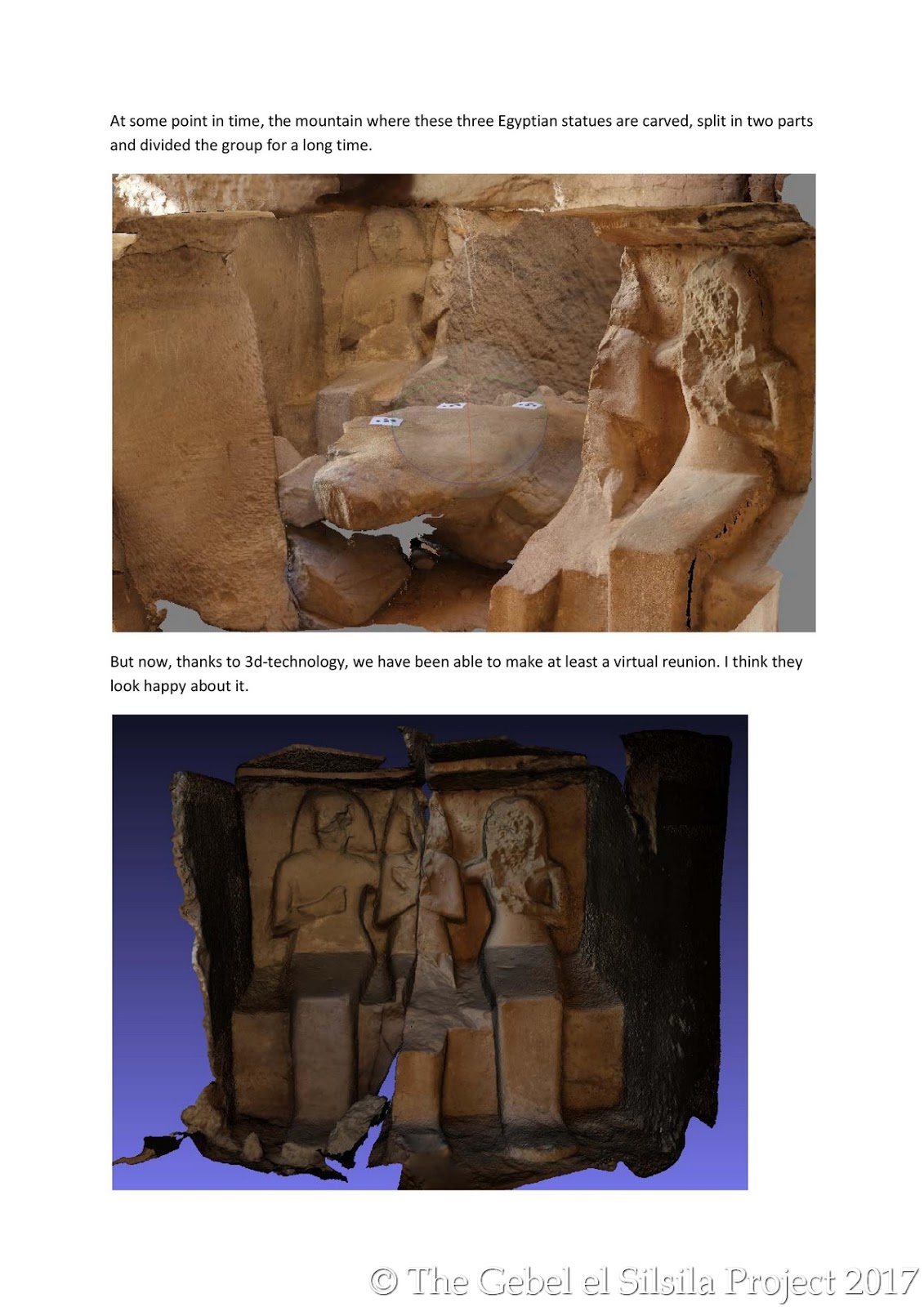
As such, we incorporate up-to-date digital technology in our work, such as 3D imaging/photogrammetry, which not only provides us with the most extraordinary ‘movable’ objects, but also the possibility to put fragmented/broken items back again without having to even touch the monument itself. As an example, we would like to share with you a preliminary reconstruction of three broken statues of shrine no. 4 (James and Caminos 1963, 16-18):  


shrine 4


The scanned monument is a room located on the southern side of shrine 4, with three statues that have been broken in three parts due to a fracture in the bedrock, plausibly caused by a natural catastrophe. The room initially measured 1.27 m deep x 1.50 m high. Three statues are seated on a bench, facing forward towards the northern-facing opening/door. The three figures depict two men (left/east and centre) and one woman (right/west). While there are no preserved inscriptions or decoration, it can be presumed that the main male figure depicts a man called Djehutmose, who was a scribe of the treasury during the 18th or early 19th Dynasty (based on an adjacent, plausibly associated hieroglyphic text) (James and Caminos 1963, 16). With the words of Stefan Lindgren, our 3D recorder from the Humanities Laboratory at Lund University: “At some point in time, the mountain where these three statues are carved, split in two parts and divided the group for a long time. But now, thanks to 3d-technology, we have been able to make at least a virtual reunion. I think they look happy about it.”


The southern group of statues

3D recorder Stefan Lindgren busy photographing an early Roman graffiti-panel


For those of you who want to ‘play around’ with the 3D image of the statues, you can find the movable object here, and below is a 'still' demonstration:


Sunday, April 12, 2015

Busy bees

Where did time go? An entire month has passed since our last blog post, then promising continuous updates and images from the field... Now more than ever, Madam Silsila has kept us busy, so much so that we find ourselves in the latter part of our spring season and with discoveries and experiences that surpasses our wildest expectations when arriving here in the beginning of March.
So, what have we been up to? Well, the exact details will have to wait, but archaeological focus has been on the northern corridor in the Main Quarry and 'Tiberius' Stables'; the ceramic analysis moved on with Pottery Hill; Egyptian epigraphy was (re-)recorded in the east bank monuments as well as in the rock-cut temple of the west (the speos) and the Nile stelae in the south.

In addition to the already introduced members, the season has included geological studies by one of our scientific 'giants', Jim Harrell; epigraphy by our other 'giant' Philippe Martinez; archaeo-ceramic studies by Sarah K. Doherty; and digital recording by Stefan Lindgren (3D) (and the team is soon to be joined by digital recorder Kevin Cain). In addition, the team has been blessed with the lovely visits by ARCE's epigraphic fieldschool under J.J. Shirley and  Will Schenck, as well as Dutch Mehen.

There is so much to summarize, but with so little time, we will leave you now with a photographic summary of the season so far.


Reis Shihad

Maria and Carter ready for another day of fieldwork
photo by Huib
John looking dapper as per usual

Liz and Hassan

Huib
Like previous seasons, Silsila always present nature's wonderful scenery


flagging the survey area

Kom Ombo's great inspectors and conservators...

... at work! 
work continues in the northern corridor of Q34

planning work in Tiberius' Stables

morning cuddles on the way out

prominent visit by General Director of Aswan, Mr. Nasr Salama; General Director of Kom Ombo, Mr. Abd el Menum, and members of the great inspectorate

Chef Abdallah!

Planning visit by Alex and Rob from DSP

morning capture of Hassan within the speos at dawn

another gorgeous sunrise over the east bank

birthday party for Nanny Sussie

Mr. Carter - born to protect the Silsila Team!

Soon to be a doctor, Mr. Moamen Saad on his way to continue documenting the Nile Stelae

Parts of the Silsila Team 2015

ARCE's epigraphic team on visit

Nanny Sussie with Freja and proud mother 

Will, J.J. & Maria

ARCE's epigraphic students with a few members of the Silsila Team, including Moamen on the scaffolding; a huge thank you to John Shearman and ARCE for lending us the scaffolding and ladders!

Our French Einstein, Dr. Martinez, arriving with gifts to Lady Freja

and with Belgian chocolate to the team!

another glorious day at Silsila

Digital recorder Stefan Lindgren

early morning photography

Our Geological Giant Jim Harrell discussing tool marks with Maria

3 men and a baby... (L-R: Philippe Martinez, John Ward, James Harrell, and of course baby Freja)

gorgeous sunset over the speos

Philippe, Jim, Maria and John in a moment of great discussion!